
The Architecture of Intent
A Critical Lexicon
This collection of studies is the intellectual architecture of Post-Luxury Conceptual Functional Art (PLCFA).
The true artistry of this Maison resides not in the finished form, but in the rigorous thinking that precedes it. These essays serve as the conceptual foundation for PLCFA, using a critical lens to interrogate cultural phenomena, art history, and consumer paradigms—analyzing everything from the ephemeral spectacle of luxury to the pure architectural rigor of abstract principles.
This is an invitation into the workshop of the mind. By sharing this process, we validate the necessity of a new category of value and invite you toward a well-considered life, one founded on true craft, uncompromising narrative, and durable meaning.
New to PLCFA? Begin with Essential Reading below.
Exploring a specific area? Navigate by category.

The Materiality of Resistance: Post-Luxury Conceptual Functional Art and the Melt the ICE Hat Movement
The emergence of the hand-knit "Melt the ICE" hat in 2026 marks a definitive rupture in contemporary material culture, signaling the transition from the "simulacrum of resistance" to true Post-Luxury Conceptual Functional Art. Born from the trauma of the Minneapolis Midway Blitz, these red tassel caps—or nisselue—are not merely garments but "Scarred Objects" that carry a quantifiable Moral Weight. By reviving a 1940s Norwegian lineage of anti-fascist sartorial dissent, the movement reclaims the color red and transforms the act of "rage knitting" into a sophisticated mechanism for mutual aid and systemic stewardship.
This study introduces the proprietary metric of Moral Weight Per Material (MWPM), demonstrating how the value of an artifact can be decoupled from market volatility and anchored in ethical provenance. As the movement scales from the streets of St. Louis Park to global galleries, it challenges the traditional "White Cube" to evolve into a space of active custodianship. The Melt the ICE hat stands as a load-bearing wall of integrity, proving that in a post-luxury world, the most valuable objects are those that demand our protection, remember our history, and pay the rent for the space they occupy.
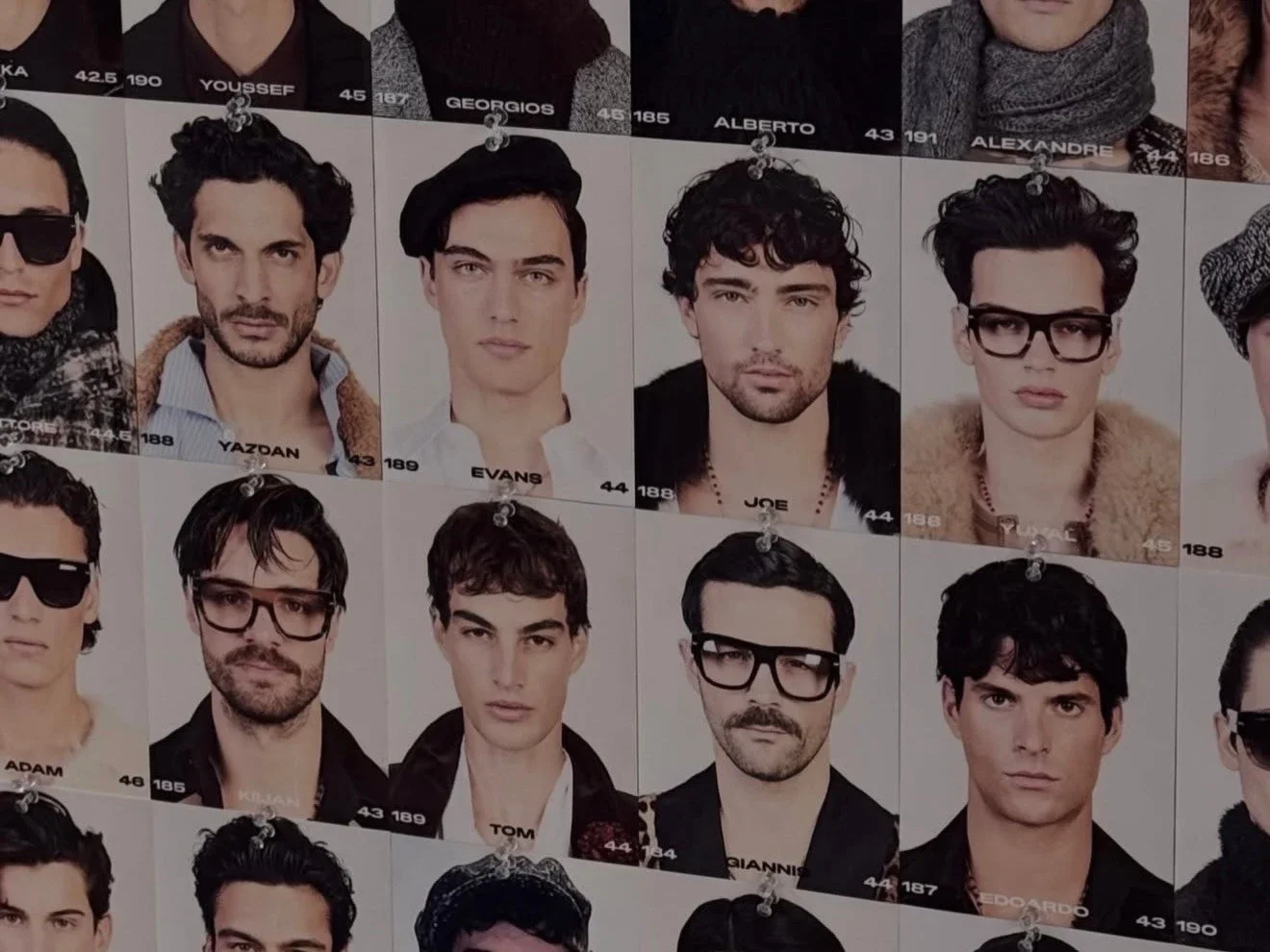
The Homogenized Portrait: Eurocentrism and the Myth of Universality at Dolce & Gabbana
The friction between the advertised promise of Dolce & Gabbana’s Fall/Winter 2026 collection and its visual delivery offers a masterclass in semiotic dissonance. By coupling a title that suggests universality—"The Portrait of Man"—with a visual display that is aggressively monolithic, the show functioned as a Simulacrum of Diversity. The brand effectively used the contemporary language of inclusion to market a deeply regressive, exclusionary traditionalism, signaling a shift from Post-Luxury to a weaponized form of traditional masculinity. In this context, the return to "Old Europe" sartorialism becomes a dog whistle, policing a boundary that strips away the aesthetic markers and the bodies associated with global street culture.
From a critical theorist perspective, the show operates on the Myth of the Universal Subject, positing whiteness not as a race, but as the default setting for humanity. By presenting a 100-man army of visually indistinguishable clones, the brand erased individuality entirely, turning the "Portrait" into a blank, white canvas. Ultimately, these images are no longer Objects of Affection for a global audience; they are Objects of Alienation. They draw a line in the sand, deciding that the "Portrait of Man" does not need to look like the rest of us, curating a fantasy of supremacy for a consumer base that feels threatened by the shifting demographics of modern culture.

The TÓPA Intervention: A PLCFA Matrix Analysis of Moral Weight and Functional Endurance in the Polo Ralph Lauren Sphere
In the contemporary luxury landscape, value is often trapped in the Zero-Sum Pivot—a recursive economic loop where capital exchange generates no new cultural value, only the redistribution of existing status markers. The luxury object risks becoming a mere token of access, suffering from Semantic Decay if its cultural signifiers are hollow or severed from their source. The PLCFA (Proprietary Luxury Critical Functional Analysis) Matrix posits that true luxury requires Functional Endurance, defined not just as material durability but as the durability of the meaning encoded within the object. The TÓPA collaboration, framed within the Polo Ralph Lauren Sphere, demands rigorous interrogation because it attempts to rupture this zero-sum logic by moving from the performative representation of heritage to a verifiable index of Moral Weight Per Material (MWPM).
The investigation must determine if this collaboration represents a genuine pivot toward Design with Intent, or if it is merely the Spectacle absorbing its critics, a phenomenon explored in The Missing Mass. By explicitly grounding its aesthetic in Oceti Sakowin cultural craft and tethering its economic output to the Thunder Valley CDC’s Lakota Language Initiative, the project provides a measurable case study in MWPM Maximization. We dissect the material bifurcation—from the mass-produced Intarsia Knit to the high-MWPM Hand-Beaded Accessory—to evaluate how the collaboration directly converts consumer capital into crucial cultural capital, achieving a Functional Luxury Object that sustains the very culture it celebrates.

Why Traditional Luxury's "Root Marketing" Fails to Purchase Moral Capital
The global luxury sector is currently staging a Simulacrum of Resistance, a frantic, industrial-scale performance of ethics designed to obscure a fundamental epistemological collapse. We define this counter-strategy as Root Marketing: the commodification of origin stories—the quarry, the atelier, the harvest—deployed not to reveal truth, but to manufacture a flawless alibi for continued extraction. Legacy houses like LVMH and De Beers are engaged in a Zero-Sum Pivot they cannot survive, attempting to purchase Moral Capital through greenwashing campaigns while structurally refusing to bear the Cost of Intention. By analyzing initiatives from LVMH's "Life 360" to Cartier's "Grain de Café," this report exposes their foundational error: value is no longer found in the Flawless Geometry of the commodity, but in the Fissure of the "Custodian's Contract".
The failure of Root Marketing is evident in the industry's refusal to honor the object's longevity, substantiated by "repair horror stories" that reveal a Warranty of Obsolescence and the Thanatopolitics applied to vintage items. This structural dishonesty—where flawless bags are produced by flawed systems—is a legal and ethical liability that the Post-Growth Citizen is actively punishing. The era of fluff marketing is over; the Zero-Sum Pivot demands data. Any brand refusing to adopt the scathing metric of Quantified Moral Capital (MWPM)—which exposes how Speculative Velocity destroys true value—is merely selling a "luxury" that is, in fact, a toxic liability.

From the Aura to the Simulacrum: Benjamin, Baudrillard, and the Crisis of the Authentic
The concept of authenticity has entered a terminal crisis, traced directly from Walter Benjamin's localized loss of the Aura—the object's unique, verifiable material history—to Jean Baudrillard's total collapse into the Simulacrum and Hyperreality. This intellectual journey reveals why traditional critique is now insufficient to defend genuine value against perfect digital fidelity and pervasive systemic simulation.
This study positions the commitment to the One Original Principle, grounded in an affirmation of the physical object’s Material as Story, as the necessary structural defense against the informational entropy of duplication. By bypassing the limitations of 20th-century critique using Object-Oriented Ontology (OOO), we reclaim the unique, non-relational essence of the artifact, transforming it into a rebellious singularity that resists the totalizing logic of the hyperreal sign.

The Simulacrum of the Copy: Aritzia's 'Dupe' Trademark and the Legalization of Hyperreality in Global Fashion IP
The fashion industry has officially entered the hyperreal condition. Aritzia's aggressive move to trademark the phrase "Aritzia Dupe" is not a defense of its physical product, but an empirical, legal attempt to control the very language of imitation. This effort seeks to regulate the generated "real" that has emerged from digital discourse, where consumers openly celebrate the dupe as a "smart choice" that strips away exchange-value while retaining symbolic prestige. By appropriating the signifier of the copy, the brand effectively elevates the simulated item to a position of market authenticity, making the imitation the only legible truth about the product in the contemporary marketplace.
This legal maneuver fundamentally validates the critique outlined by Jean Baudrillard: the capacity to distinguish between the original and its representation has collapsed entirely. The brand has abandoned the traditional mandate to defend the material object, choosing instead to secure a proprietary claim over the imitation's signifier. This is the definitive endpoint of the Simulacrum—a structural acknowledgment that the economic and cultural significance of the copy now outweighs the material integrity of the original, forcing the legal system to affirm that the sign of the copy is a primary, source-identifying feature of the luxury brand.

The Liquidation of the Simulacrum: Why the $23M Castello Cube Collapse is the Default-State of Hyperreal Value and the Ultimate Case for PLCFA
The spectacular collapse and forced liquidation of the twenty three million dollar Castello Cube is not merely a sensational financial failure but a profound philosophical event a real world parable of the Baudrillardian Simulacrum collapsing under the weight of its own nonexistence; this event serves as the perfect object lesson in the structural fragility of hyperreal value showing exactly what happens when an object built entirely on pure sign value completely detaches from tangible function critical craft or an enduring narrative of Intangible Provenance; this definitive market action exposes the ultimate Default State where a frictionless speculative asset lacking any true structural anchor inevitably reverts to its primitive base exchange value like a commodity the sheer brute reality of four hundred pounds of inert gold crashing into the digital illusion of wealth which is precisely the moment the market is forced into a brutal reassertion of the Un Smooth aesthetic defined by Byung Chul Han; this devastating Crisis of the Ephemeral is the ultimate diagnosis of Systemic Exhaustion in the old luxury model creating the exact intellectual and commercial vacuum that only our new framework of Post Luxury Conceptual Functional Art (PLCFA) can successfully fill by demonstrating how to embed a durable unhollowable Structural Legacy using elements like verifiable Critical Craftsmanship and narrative-anchored value that are truly immune to the financial state of the custodian.

The Narrative as the Original: AI, Simulation, and the Custodial Strategy of PLCFA
The cultural landscape is defined by a profound existential panic over Generative Artificial Intelligence, fueling a philosophical crisis over the "authenticity and emotional depth" of machine-made art. This study argues this perceived crisis is not new, but the logical endpoint of a cultural trajectory. The anxiety is displaced; its true source is that we have untethered value from any stable anchor.
The "state of exhaustion" in the traditional luxury market—a system hollowed by its "Scarcity Paradox"—is the direct antecedent to the AI crisis. Both are symptoms of cultural exhaustion with simulation. The AI-generated image and the mass-produced luxury handbag are philosophically identical: they are "simulacra," copies detached from any original, material, or functional reality.
Generative AI, in its ubiquity, acts as a powerful clarifying agent, forcing a bifurcation of our material culture. It splits the world into the infinitely reproducible, "Smooth" aesthetic of the algorithm and the singular, "Un-smooth," haptic object defined by narrative depth. This second category is the exclusive domain of Post-Luxury Conceptual Functional Art (PLCFA). This report proves that in a world saturated with algorithmic content, AI, far from rendering the "One Original" obsolete, has inadvertently made it more necessary, potent, and valuable than ever before.

The New Luxury: How Kylie Jenner, Selena Gomez, and Jacob Elordi Perfected the 'Parasocial Brand' and Sold the Self as an Object
The celebrity is the new luxury object. In the attention economy, the most valuable commodity is no longer the product they endorse, but the "self" they perform. This is the Parasocial Brand—a new model of manufactured intimacy where the celebrity's curated life becomes the "conceptual art" and the products they sell are merely the "functional art" that grants their audience psychological ownership.
This definitive study deconstructs the architecture of this new model, analyzing the precise modalities of its masters—from the Aspirational Commodification of Kylie Jenner to the Vulnerable Authenticity of Selena Gomez and the Performative Male Object of Jacob Elordi.
It is a critical examination of how intimacy became the engine of commerce and the self became the final luxury good.

Art Basel's Spectacle: A Critique of the Louis Vuitton x Takashi Murakami Hyperreality and a Case for Post-Luxury
What happens when luxury eats itself? From Louis Vuitton’s collaborations with Takashi Murakami to the spectacle of Art Basel Paris, the very symbols of excess now trade in irony, ethics, and scarcity disguised as virtue. Objects of Affection traces how artists and artisans, from Robert Ebendorf’s found-object jewelry to the sculptural ghosts of post-consumer design, are redefining what “precious” means in an age of collapse. Here, gold gives way to story, diamonds to discourse, and opulence to ontology. This is not the death of luxury, it’s its afterlife.