The Animal Is Not in It: A T. Rex Handbag Nobody Bought
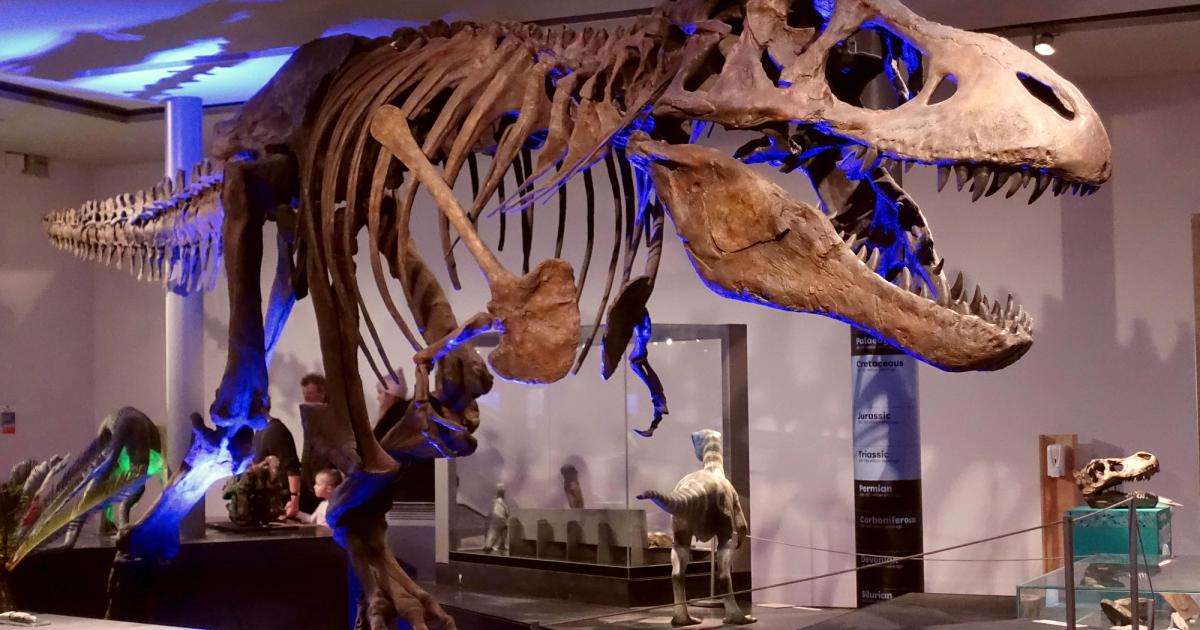
On 11 June 2026 a handbag went to auction in Paris carrying the most extraordinary provenance claim ever attached to a fashion object. It was described as the first bag made from Tyrannosaurus rex leather. The estimate was three hundred to five hundred thousand euros.
Bidding stopped at one hundred and fifty thousand and the lot was bought in. It did not sell.
That is the finding, and it is worth more than the object. A market was offered a sixty seven million year old origin story and declined it at half the low estimate.
What was actually offered
The sale was Tentation number four at the Hotel Drouot, presented by the auction house Giquello, and the announcement set out the object: a single bag, twenty six by eighteen centimetres, made by the techwear label Enfin Leve, founded by the Polish designer Michal Hadas.
The material is where care is required, because the popular description and the technical one are not the same claim. The bag is not made from collagen extracted out of a dinosaur bone. The reporting describes work by Lab-Grown Leather Limited with The Organoid Company in which Tyrannosaurus protein sequences were RECONSTRUCTED and expressed in cellular systems to grow a collagen-based material.
Read that difference slowly. A reconstructed sequence is a model. The output is a real material and it is grown from an inference about an extinct animal, not from the animal. The Scientist put the question in its own headline, asking whether it is really dinosaur collagen at all.
So the object carries an origin claim with no physical chain to the thing it invokes. Nothing travelled from a femur to this bag. What travelled was information about a protein, and the confidence in that information is itself contested.
What the maker said, and what this study does not claim
Every question this study was about to put to the laboratories turns out to be answered on the public record, and one of them by the company’s own chief executive.
The sequences were not read off a specimen. They come from collagen peptides reported in earlier research and lodged in a public protein database, and the gaps between them were filled by a protein language model USING CHICKEN COLLAGEN AS THE TEMPLATE. No physical fossil material entered the process at any point.
And the company said so itself. Che Connon, chief executive of Lab-Grown Leather, told The Scientist by email: “Our LLM has essentially generated a highly accurate digital facsimile of T. rex collagen.” Separately in the same message he set a condition on it: “Until [paleoproteomics] advances to a point where overlapping fossil fragments map out the entire sequence piece-by-piece, our AI’s sequence remains a brilliant approximation of prehistoric biology rather than an exact historical match.”
Read that quote as a provenance statement, because it is one, and it is a good one. It names what the thing is, names what it is not, and declines the stronger claim that was available to him. An institution that spends its time asking makers to describe objects precisely should say plainly that this is precision.
The paleontologist whose work produced the peptides the whole project rests on has been blunter, and her qualifier is part of the quotation rather than a softening of it. Mary Schweitzer: “In my opinion, they don’t have T. rex leather. In fact, I’m not even really sure they have T. rex proteins.”
What this study does not establish is where the stronger version came from. The statement above was made by email to a science publication and it carries its condition with it. The version that reached the saleroom and the headlines carried no condition at all. This study does not assert how that happened.
It does not need to. The argument here rests on something simpler and checkable: there is no chain of custody for this object, and there could not be. That holds whoever said what, and it is the only thing this institution is in a position to establish.
A claim about origin is not a claim about an object
This institution has recently had cause to state the difference precisely, and this bag is the cleanest illustration of it that could have been arranged deliberately.
Authentication is a claim about a thing at a moment: this object is what it is said to be. Provenance is a claim about a sequence of relationships across time: this thing came from there, held by these people, transferred on these dates. A certificate is complete when issued. A provenance record accrues and is never complete, which is why a declared gap is normal in one and a defect in the other.
The T. rex bag was offered as though it had provenance and could only ever have had authentication, and arguably not even that. There is no custody chain because no custody occurred. There is a laboratory process, a proprietary material name, and a story about a femur. Every one of those may be entirely honest and none of them is a chain.
A working test, and it is the one this institution keeps returning to: remove the name and see what remains. Strip the word Tyrannosaurus and the lot is a small handbag in an unusual lab-grown collagen composite by a niche label. Nobody estimates that at half a million euros.
Which makes it a Hollowed Object in the strict sense rather than the rhetorical one. The value is not partly semiotic. It is entirely semiotic, and the room said so.
The bid is the most honest number in the story
An estimate is a hope with a house behind it. A hammer price is a decision. A lot that fails to sell produces something rarer: a bid that stopped, in public, at a knowable figure.
One hundred and fifty thousand euros is not nothing. Somebody was willing to pay it. But it is the point at which the story stopped being worth paying for, and it sits at roughly half the low estimate. This institution has argued that speculative velocity carries prices past anything underneath them; here the mechanism failed in public, and the failure is better evidence than a sale would have been.
A sale tells you one buyer accepted a story. A buy-in tells you the room, collectively, did not. On this occasion the market performed the verification the object could not.
Where this leaves material singularity
This institution holds that Material Singularity must be earned in the object and demonstrable there. The bag is the hard case from an unfamiliar direction.
It is genuinely singular. There is one of it. The material is genuinely novel and the science behind growing collagen from a reconstructed sequence is genuinely difficult. None of that is in question, and it deserves to be said plainly rather than buried under the auction result.
What it lacks is the link between the singularity and the story being sold. The rarity is real and the sixty seven million years are doing the pricing, and those are two different properties. An object can be unrepeatable and still be carrying a claim it cannot support.
That is the distinction this institution exists to hold, and it applies with more force to a laboratory material than to a scarce one, because a grown material can be made again while a story about a specific femur cannot be checked at all.
What is not established here
This study asserts nothing about the honesty of any party. Enfin Leve, Lab-Grown Leather Limited, The Organoid Company, the designer and the auction house are named because they are the parties on the public record, and no statement here alleges that any of them misrepresented anything. The distinction drawn is between what a provenance record can carry and what this object could carry, which is a statement about the category rather than about anyone's conduct.
The scientific question of whether ancient protein sequences can be reconstructed to the confidence claimed is CONTESTED IN THE LITERATURE AND IS NOT SETTLED HERE. This institution has not read the underlying research, has not spoken to the laboratories, and takes no position on the biology. The study's argument does not depend on the science being wrong; it depends only on the absence of a custody chain, which holds either way.
The auction result is reported from published trade and news coverage. No catalogue was obtained, the reserve is confidential and is not stated, and no figure here should be treated as a hammer price, because there was none.
No statement has been sought from any party as of publication. Where a party responds, this study will be revised to carry what they say.
The material facts in this study, including the database provenance of the peptides, the use of a chicken collagen template, the absence of any physical fossil material, and the quotations from the company's chief executive and from Mary Schweitzer, are drawn from a single science publication. THIS INSTITUTION COULD NOT FETCH THAT SOURCE DIRECTLY: the host returns an identical refusal for a real page and for an address that cannot exist, so it cannot be verified by this seat's usual method. It was read in full by a second seat and reported here. That is a weaker warrant than a checkable link and it is stated rather than hidden.
No party is alleged to have misrepresented anything. The chief executive’s statement quoted above, made by email to a science publication, is precise on its own terms and declines the stronger claim that was available to him.
A note on how this study was checked, because it bears on the study’s own subject. The two statements from the chief executive are SEPARATE sentences from one email and are presented here as separate, because an earlier draft of this study ran them together as a single continuous description. Joining them would have been a paraphrase wearing the clothes of a quotation, on the sentence this study’s argument rests on, about a named company. The conditional opening of the second statement, which makes it a scientific caveat about what is not yet possible rather than a flat disclaimer, was absent from that draft entirely.
The Mary Schweitzer quotation lost its opening three words, “In my opinion”, on its way into this study. With them she is stating a considered view. Without them she reads as announcing a finding. This study reports her as dissent and does not adopt her position, so those three words carry the whole distinction.
BOTH LOSSES ARE OF THE KIND THIS STUDY EXAMINES, OCCURRING INSIDE THE STUDY ITSELF. An accurate statement shed a qualifier while being carried from one party to another, twice, between colleagues who were being careful. Neither was caught by rereading. Both were caught by going back to the source.
Coda
A bag was offered with the oldest origin story in the history of fashion, and the room valued the story at less than half what was asked. The material is real. The animal is not in it. Somewhere between those two sentences is the entire subject of this institution.