Shoegaze history & slackers music: Essential guide to 1984-1994 rock

On the offset guitar, the wall of pedals, and how a sound built from specific machines became a filter you can apply with a thumb.
Simon Reynolds began covering this music for Melody Maker in 1986, which means that Still In A Dream: Shoegaze, Slackers and the Reinvention of Rock, 1984 to 1994 is not a historian’s reconstruction but a witness’s return. That distinction matters, because the movement the book documents was, more than almost any in rock, a movement about machines(specific guitars, specific pedals, specific studio methods) and it is being revived, right now, as a mood you can summon without owning any of them. The gap between those two facts is the whole subject of this study.
Our interest is not nostalgia. It is a question the Objects of Affection Collection asks of every cultural form: what, exactly, is the material substance of the thing, and what happens when the market learns to sell the thing without the substance? Shoegaze is the rare case where the answer can be measured in hardware.
The Sound Was a Machine
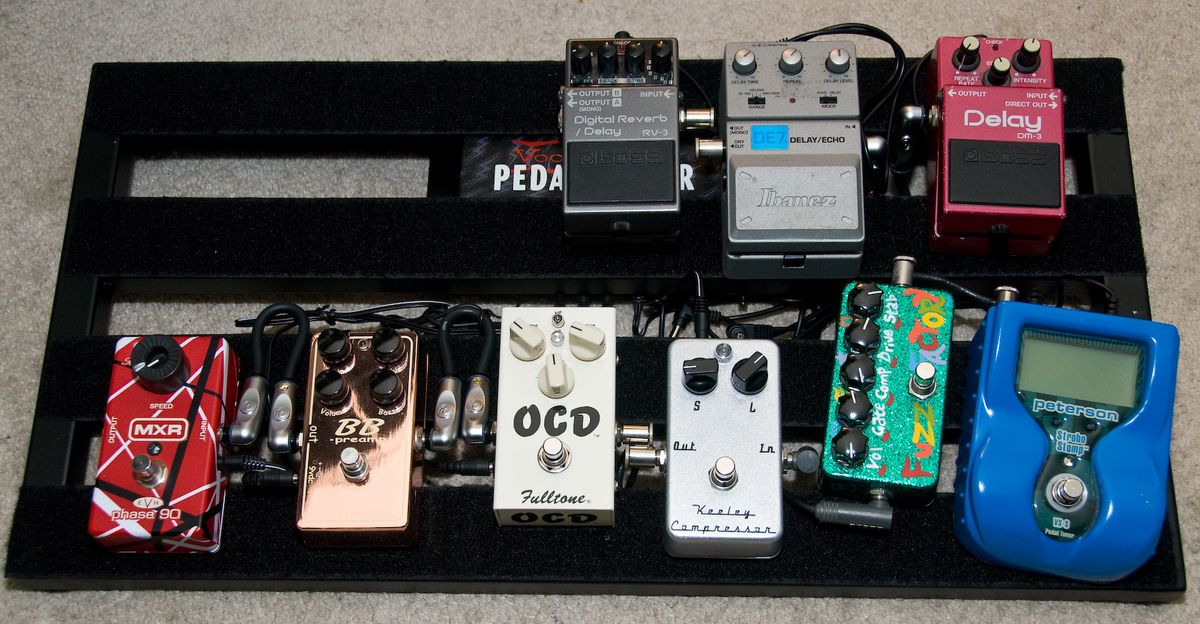
Shoegaze earned its dismissive nickname honestly: the musicians appeared to stare at their shoes onstage. They were not shy. They were reading their feet, because the sound lived down there, in banks of effects pedals that had to be triggered in precise sequence, a choreography of toes rather than a performance of faces. The downward gaze was not affect. It was a job requirement dictated by the equipment.
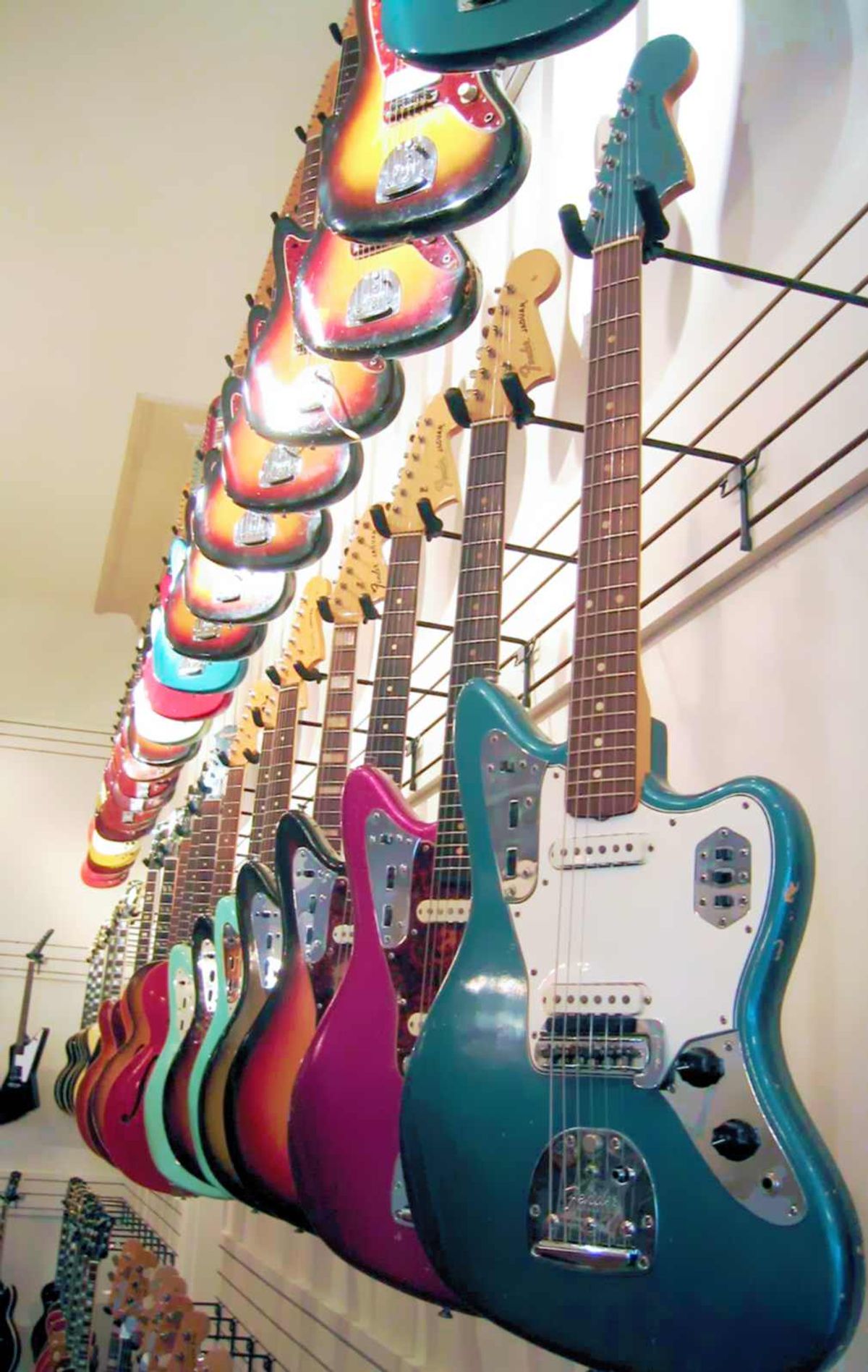
That equipment is unusually legible. The genre’s canonical instrument is the Fender offset: the Jazzmaster and the Jaguar, guitars with a floating tremolo arm and bright, glassy single-coil pickups that had been unfashionable for a generation before these bands rediscovered what they could do when routed through enough reverb and modulation. Kevin Shields of My Bloody Valentine developed his signature “glide guitar” by holding the tremolo arm and bending the pitch of an entire chord as it rang, a technique inseparable from the specific hardware that permitted it. You cannot play glide guitar on an instrument that lacks the mechanism. The sound is the machine.
There is a deeper irony in the hardware. Fender designed the Jazzmaster in 1958 for jazz players, who almost entirely rejected it; its bright, unusual voice found no home in the genre it was named for, and the guitar drifted into pawn-shop obscurity, cheap because unwanted. It was the surf bands, and two decades later the indie and shoegaze undergrounds, who reclaimed the discarded instrument precisely for the qualities its intended market had refused. The offset is thus a Sedimentary Object twice over: an unwanted machine whose material character lay waiting, for thirty years, for an aesthetic that needed exactly it. The sound did not choose an arbitrary tool. It found the one instrument the market had thrown away.
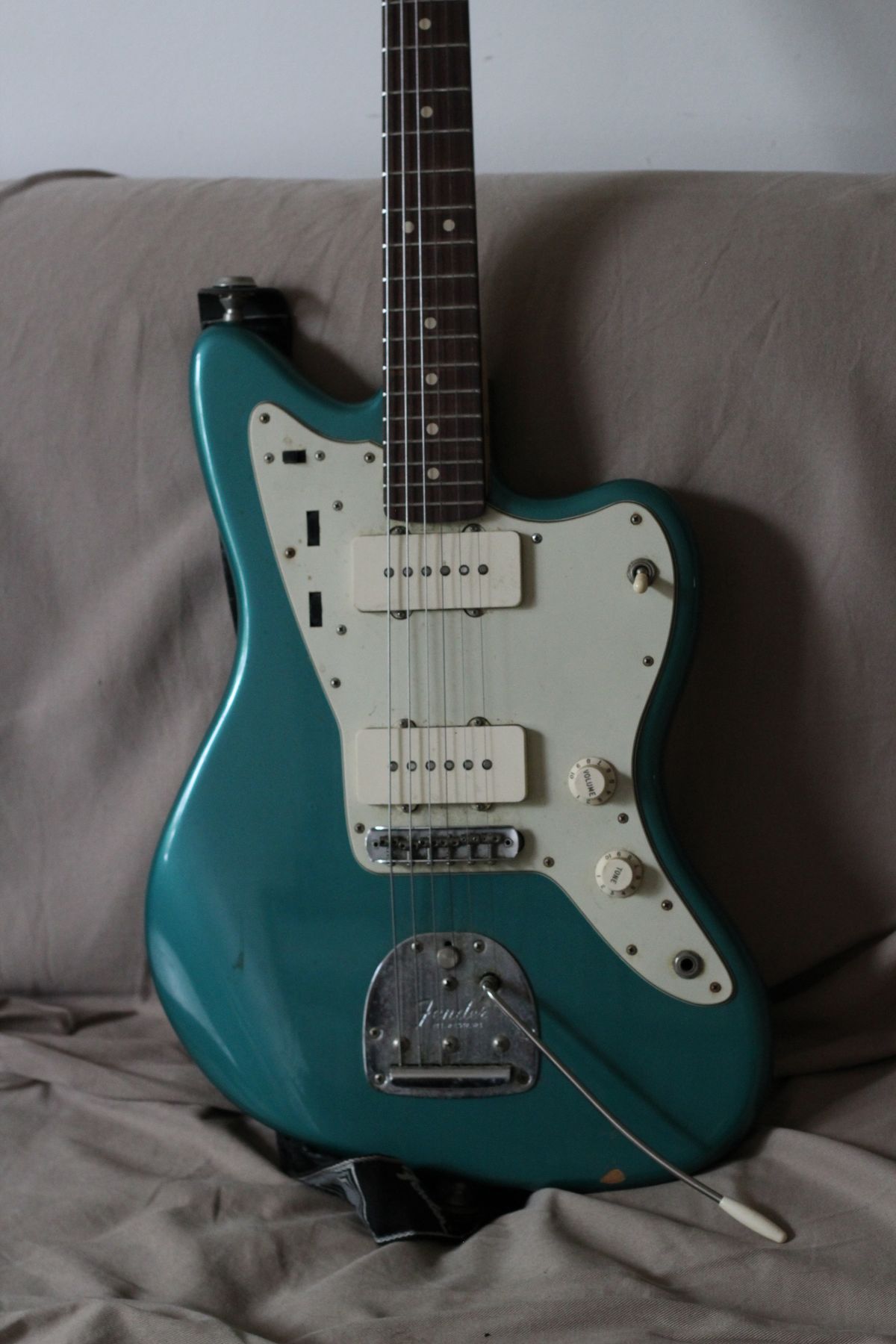
The downward gaze was not shyness. It was a musician reading a machine that authored half the sound.
This is what we mean by Material Singularity: an aesthetic that cannot be abstracted from its physical substrate without ceasing to be itself. A shoegaze chord is not a note plus a “shoegaze setting.” It is the irreducible product of a particular guitar, a particular chain of pedals, a particular room, and a particular pair of hands that spent years learning the chain. The sound has a body, and the body is made of aluminium, magnets, and analog circuitry.
Loveless, or the Price of the Covenant
If shoegaze has a scripture, it is My Bloody Valentine’s Loveless, recorded in fragments between February 1989 and September 1991. The legend around it is a legend about cost. The album is rumoured to have run to £250,000 and to have nearly bankrupted Creation Records, whose owner Alan McGee eventually dropped the band and signed a co-ownership deal with Sony to stay solvent. Shields disputes the figure; he has put the real number closer to £140,000, and called the bankruptcy story a myth McGee inflated because “he thought it would be cool.” Even the deflated number includes a reported £15,000 spent chasing a single guitar loop.
We do not need to settle the accounting to read the meaning. Whether it was one hundred and forty thousand pounds or a quarter million, the money is a measure of Labor Density the sheer quantity of human attention, time, and material trial compressed into the object. Two and a half years for eleven tracks. A five-figure sum for one loop. This is the opposite of frictionless production. It is a covenant paid for in studio hours, and the price is not incidental to the art. The price is the art’s proof that someone treated the sound as though it mattered enough to nearly go under for.
The cost of Loveless is not a scandal to be corrected. It is the receipt for a covenant, and the receipt is part of the work.
Part of what the money bought was time inside analog signal paths that behave in ways no preset fully repeats. Analog reverb and magnetic tape are not neutral carriers; they colour, compress, and distort in the very act of recording, so that the medium deposits itself into the work. Shields treated the studio as an instrument to be played rather than a room to be documented in, layering and re-layering until the guitars stopped sounding like guitars and became a kind of weather. That is not a setting you dial in on a screen. It is a material process with a duration and a cost, and both the duration and the cost remain legible in the result.
Set this against the way the market prefers its culture: cheap to make, fast to move, infinitely reproducible, and the offense of Loveless becomes clear. It refused Speculative Velocity at the level of production itself. You cannot rush it, and you cannot cheaply counterfeit the conditions that produced it. That refusal is exactly what makes it, decades later, so tempting to counterfeit.
The Anti-Performance
The “slackers” half of Reynolds’s title names the movement’s posture as much as its personnel. Where the dominant rock economy ran on the frontman: the charismatic face, the arena gesture, the body sold as spectacle, these bands turned away. They stood still. They pointed the light at the smoke rather than the singer. In an industry organised around the Aura Transaction, in which a star’s presence is the product being sold, the shoegaze stance was a quiet act of refusal: the aura was dispersed into the sound, not concentrated in a personality.
It is easy to romanticise this, and we should resist doing so completely; anti-performance is still a performance, and the refusal of spectacle became, in time, its own marketable image. But at its origin the gesture carried a genuine Anti-Commodity Commitment. The band that will not perform its own celebrity is a band withholding the very thing the industry most wants to sell. The downward gaze denied the camera its face.
The refusal had a physical dimension the recordings only hint at. My Bloody Valentine’s live sets became notorious for an extended passage of pure, punishing volume: minutes of overwhelming noise pitched at a threshold that has the band handing out earplugs at the door. This was not spectacle in the ordinary sense; there was nothing to look at. It was sound made so materially present that the audience felt it in the chest and the teeth, an intensity that cannot be photographed, and cannot be streamed at its true level. The event was irreducibly physical, and irreducibly there. You had to bring your body to it.
The voice underwent the same submersion. Where rock convention pushed the singer to the front and the lyric toward legibility, shoegaze buried the vocal in the mix until words dissolved into another band of texture: the human instrument processed like any other. In the Cocteau Twins, whose shadow falls across the whole era, Elizabeth Fraser often sang in what was effectively an invented language, shedding the Semantic Burden entirely so that the voice could become pure material sound. Meaning was not the point. Presence was.
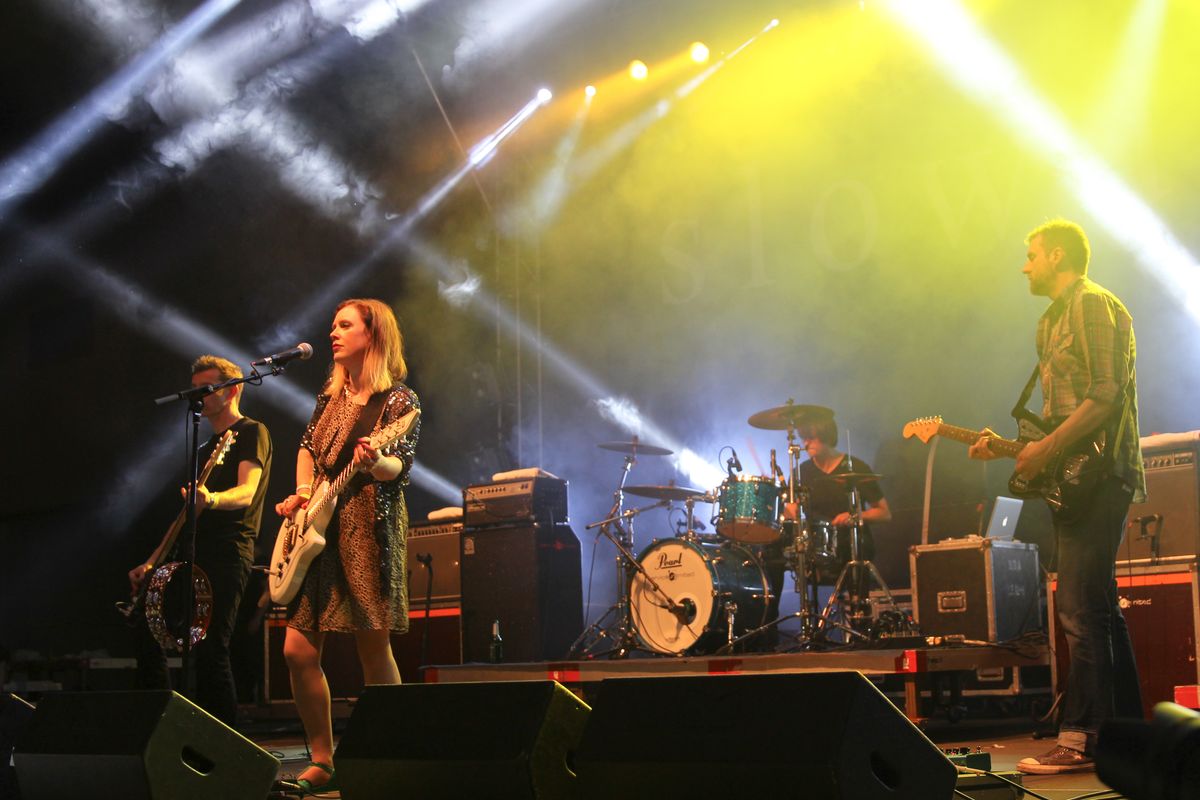
What the era offered instead of a face was an environment: volume, texture, and light as an immersive material condition rather than a backdrop to a star. The nearest thing in our own archive is the account of standing inside light as a physical presence rather than looking at an image of it. Shoegaze wanted to do to sound what that does to light: make it a room you enter, not a thing you watch.
Reynolds and the Retromania Trap
Here the study must turn on the book itself, because Simon Reynolds is not a neutral chronicler. He is the critic who gave us the word retromaniahis diagnosis of a culture addicted to recycling its own past, unable to generate a present that is not a curated reissue of something prior. For that critic to write the authoritative history of shoegaze, at the precise moment shoegaze is being revived as a retro aesthetic, is a knot worth pulling on rather than smoothing over.
An authoritative retrospective performs two opposite functions at once. It is an act of Narrative Permanenceit fixes the movement’s meaning, honours its labor, keeps it from being forgotten. And it is, simultaneously, a step in the very reification it might wish to resist, converting a lived and once-oppositional practice into a canon, a reading list, a set of records to acquire. Our own Reviewer flagged this tension in the source material, and it is real: the same book that preserves the covenant also packages it. There is no clean way out. The honest move is to name the knot, not to pretend the historian stands outside the market he describes.
The Revival as Hollowed Object
Now to the machine’s afterlife. Shoegaze is, as of this writing, enjoying a broad revival: a wave of young bands and, more tellingly, a flood of short-form video in which the aesthetic circulates as a mood: a hazy filter, a reverb-drenched fifteen seconds, a tag. This is where our framework earns its keep, because the revival is not simply shoegaze returning. It is, in its dominant form, shoegaze hollowed.
The Hollowed Objectis the form from which the substance has been drained and replaced by its own signature. A shoegaze preset: the reverb, the wash, the slowed vocal, delivers the signifierof the sound while shedding everything that gave the original its density: the specific broken-in Jazzmaster, the pedal chain built over years, the £15,000 loop, the two-and-a-half-year covenant. The aesthetic becomes a texture you apply, not a thing you build. This is aesthetic arbitrage: the extraction of value from a movement’s recognisable surface while its costly interior is left behind as unprofitable.
The mechanism is worth naming precisely, because it is not unique to music. A dense form throws off a small number of instantly recognisable surface cues; the market isolates those cues, reproduces them at near-zero cost, and circulates them at speed until the cue and the form become synonymous in the general ear. At that point the expensive interior is not merely forgotten; it becomes invisible, because the surface now is the thing as far as the market can perceive. The reverb wash stands in for the whole covenant, and a signifier that has swallowed its referent is the exact definition of a hollowed form.
We are careful here not to be snobs about it. Access is not theft, and a teenager discovering the wash of a guitar through a phone is not committing a crime against Kevin Shields. The critique is structural, not moral. When a form’s market value migrates entirely to its most easily reproduced signifier, the velocity of that signifier begins to define the form, and the slow, expensive, material practice that produced it comes to look like mere trivia, a origin story nobody needs in order to sell the mood. The danger is not that people enjoy the revival. It is that the revival forgets there was ever anything to preserve but a filter.
What the Machines Knew
The deepest claim in Reynolds’s material, and the one our framework most wants to defend, is that the offset guitar and the wall of pedals are not nostalgia props. They are the body of the sound, and a body cannot be swapped for a description of itself. This is Material Memory: the way an aesthetic is stored not in the idea of it but in the physical apparatus and the trained practice that reproduce it.
Consider what is actually lost in translation from machine to preset. The pedal chain introduces accidents: a hum, a nonlinearity, an interaction between two circuits that no one designed and no one can perfectly model. The offset’s tremolo permits a gesture, glide guitar, that is a physical event in time, not a parameter. The room adds itself. These are not bugs to be cleaned up in the digital reissue; they are the grain of the thing, the irreducible remainder that a simulation approximates but never contains. To hold shoegaze as a living form is to hold that remainder: the machines and the hands, and not merely the recording of its surface.
The same lesson recurs wherever craft meets its own market image. We have watched heritage artisanry made structurally captive to the speculative machine that packages it, until the labor is honoured in the advertisement precisely as it is hollowed in the product. Sound is no different. A genre defined by the density of its making is uniquely vulnerable to a revival that keeps the density’s appearance and discards its cost.
Custody of a Sound
How, then, does one hold custody of a sonic heritage: something with no single object to lock in a vault? Two wrong answers present themselves. The first is to freeze it: to treat shoegaze as a sealed museum period, its records canonised and its practice embalmed, which is a kind of Archival Death that honours the form by ensuring nothing living comes of it. The second is the revival’s answer: to flatten it into a preset, infinitely available and materially empty.
The custodial path runs between them, and it is a matter of preserving practice rather than merely product. It means keeping the actual apparatus in use: the offsets, the analog chains, the studio methods, and keeping alive the knowledge of why the expensive, slow way of making the sound produced something the cheap fast way cannot. It means treating a book like Reynolds’s as a set of working instructions for a covenant, not a shopping list for a canon. A sound is kept not by owning its recordings but by continuing to be able to make it, materially, at its true cost. That continuity, not the reissue, is the Burden of Preservation a living heritage actually asks its custodians to carry.
In practice this looks less like a museum than a workshop. It is the technician who still repairs the offset’s tremolo, the small maker who reissues a discontinued pedal to its original analog circuit rather than a digital emulation, the musician who learns glide guitar as a physical discipline instead of loading a plug-in that merely names it. Custody of a sound is distributed across everyone who keeps its means of production alive and in tune. Lose the practitioners and you do not lose the recordings; those persist; but you lose the capacity to make the thing new, which is the only form of preservation a living art can actually use.
Coda
The bands stared at their feet because that is where the sound was: in the machines on the floor, waiting to be triggered in the right order at the right instant. Thirty years on, the sound is everywhere and the machines are nowhere, dissolved into a filter that anyone can wear and no one has to build. This is not a tragedy; it is a transaction, and like every transaction the Objects of Affection Collection examines, it trades a dense and costly interior for a light and portable surface. Simon Reynolds returned to this era, after years of not thinking about it, because he wanted to stand once more inside the thing before it finished becoming its own echo. The revival will do what revivals do. Our task is only to remember, and to say plainly, that the dream was made of hardware, and that a sound you can summon without the machines is a sound with its body left behind on the studio floor.