Nengi Omuku: Sanyan Painting Under Speculative Pressure
On material memory, speculative hunger, and the work that refuses to be made abstract.
There is a canvas that precedes the painting. Before Nengi Omuku applies a single brushstroke, the surface she works on has already been woven, worn, stored, and carried across two centuries of Nigerian ceremonial life. The sanyan she uses is not a neutral support. It is an argument in fabric form: that the object carries meaning prior to the artist's intention, and that painting on it is an act of custodial inheritance as much as creative production.
OAC takes this premise seriously, which means also taking seriously its opposite pressure. The contemporary art market does not share the object's patience. In October 2023, Omuku's 2021 work Love-Life-Bleeding sold at Sotheby's London for £22,860, against a pre-sale estimate of £5,000 to £7,000. The mid-estimate was £6,000. The work sold for approximately 281 percent above it. The number is not incidental. It names the arrival of Speculative Velocity, and Speculative Velocity has never respected a material covenant.
I. The Fabric Before the Paint
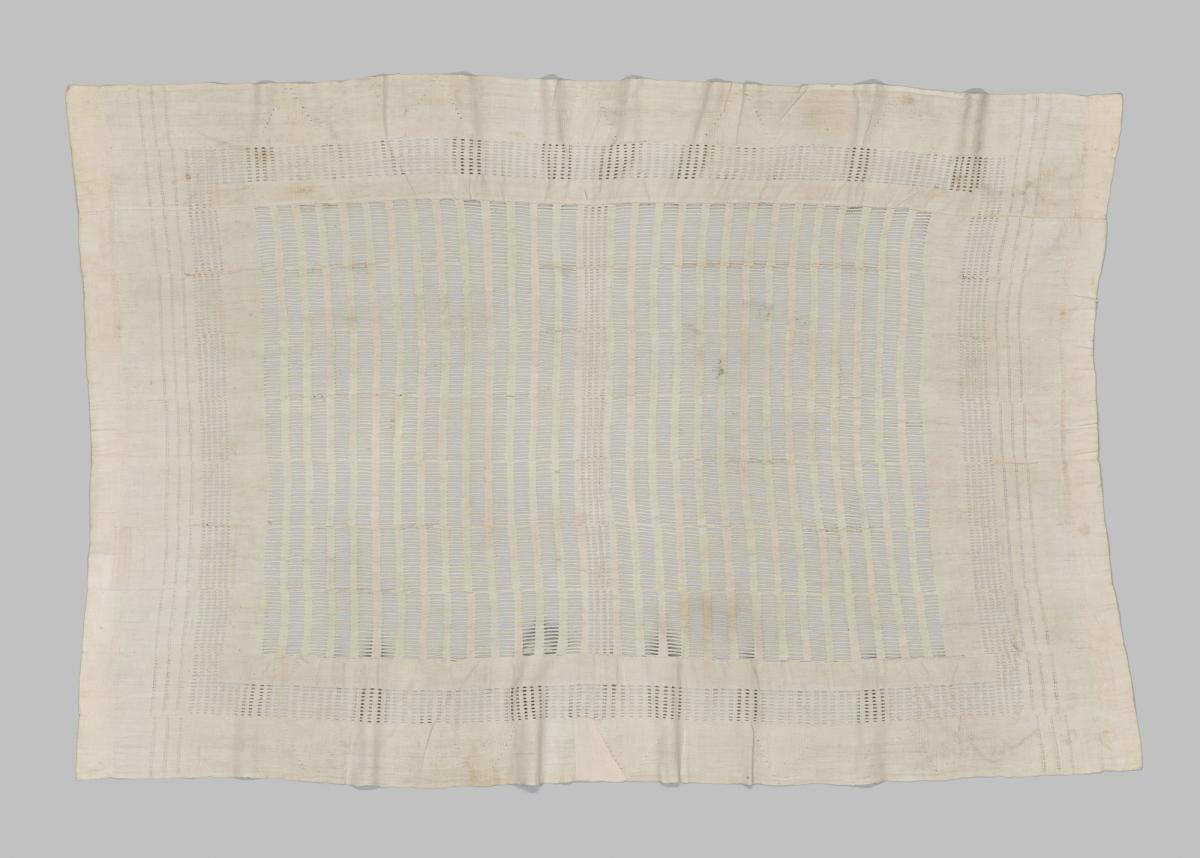
Sanyan is the most luxurious form of aso oke, the hand-woven prestige cloth of the Yoruba people in West Africa. Composed of indigenous wild silk and cotton threads, it has functioned for centuries as a material register of ceremony: worn at coronations, weddings, and funerals, it marks passage and permanence simultaneously. The textile is not produced quickly. A single garment requires substantial labor across multiple stages of spinning, weaving, and finishing. This is not craft in the contemporary gallery-market sense of the word, meaning artisanal as aesthetic premium. This is Labor Density in its most literal form: accumulated hours of skilled practice, knowledge encoded in the pattern structure, cultural legislation governing when and by whom the cloth may be worn.
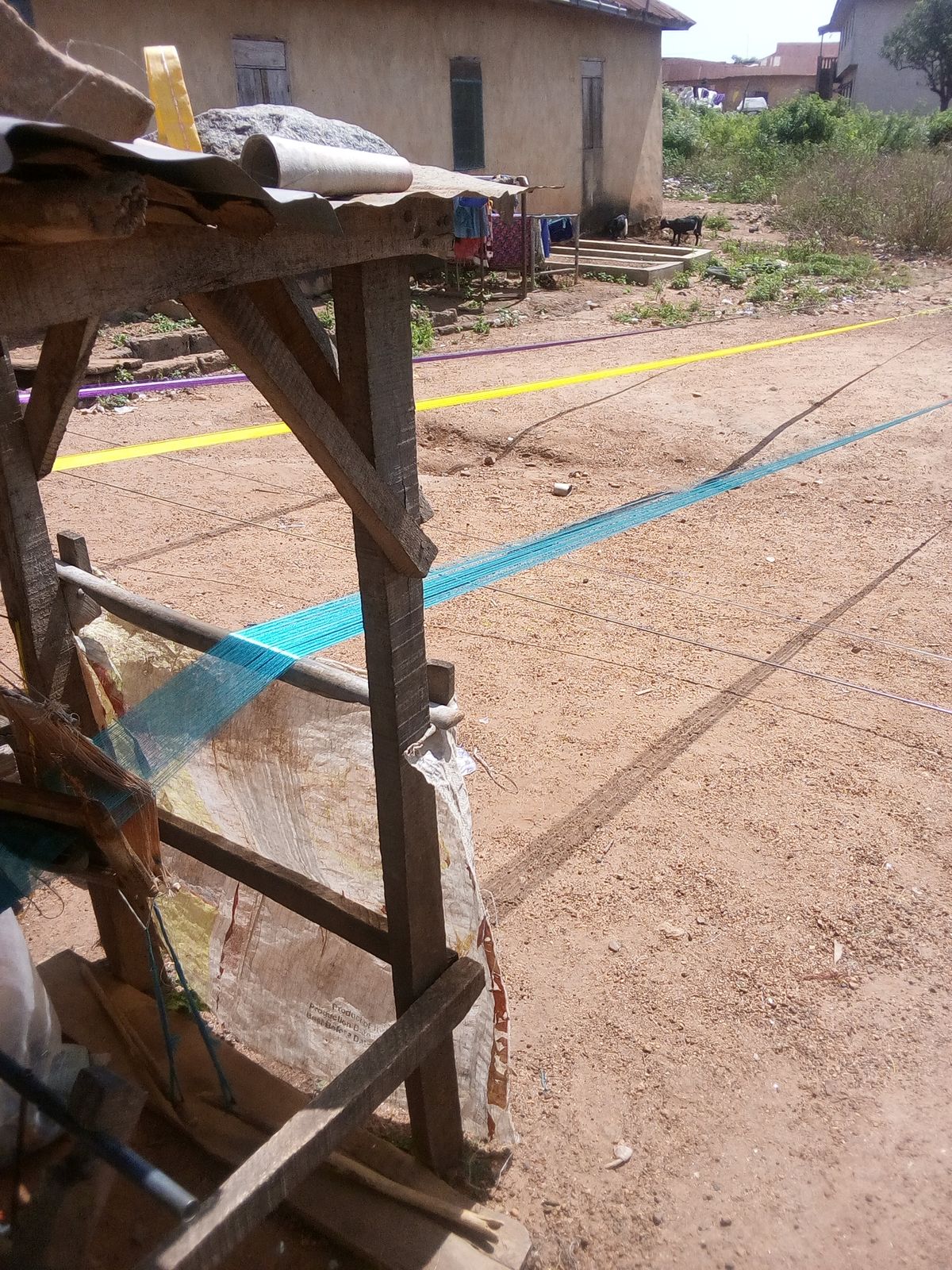
To hold a length of sanyan is to hold time. The tradition is not custodied by a museum or a foundation but by the women and men who still practice the weaving, carrying forward techniques that predate the colonial encounter with West Africa and survived it. No industrial process replicates genuine sanyan. The hand-spinning of the indigenous silk component alone requires knowledge that cannot be transferred by instruction manual. It is held in hands, in attention, in the slow correspondence between the weaver's body and the loom.
The significance of Omuku's substrate choice is not primarily aesthetic, though the aesthetic consequences are considerable. The gessoed reverse of the woven textile receives oil paint differently from linen or cotton canvas. The structure beneath the gesso creates a resistance and a texture that no commercially prepared support provides. But the material choice is not made for the surface effect it produces. It is made for what the fabric already is before she begins. In the PLCFA reading, this is Material Singularity: the property of an object that cannot be reproduced by substituting an equivalent material, because the specific material is constitutive of the meaning. An Omuku painted on Belgian linen would be a different kind of claim entirely, and a weaker one.
"The reason why I'm working with the fabric has to do with nostalgia, longing for a time in Nigeria where things were beautiful." -- Nengi Omuku
That longing is not decorative. It is a structural argument about what the object should carry and what it should refuse. Sanyan was never a commodity fabric. It was produced for specific occasions, worn by specific people, passed between generations as a marker of lineage and belonging. Omuku's use of it as a painting support does not sentimentalize this history. It extends it into a new formal context while insisting that the history travel with it. The painting cannot be separated from the fabric. The fabric cannot be separated from its culture. This is the foundational claim, and it is a serious one.
II. The Slade Problem and the Return
Nengi Omuku received her MA from the Slade School of Fine Art in London in 2012. The Slade is one of the oldest and most conservative traditions of oil painting instruction in the British academy. It produces painters in the European technical sense: artists who have absorbed Cézanne and Bacon and Auerbach as structural problems, who understand pictorial space as a problem inherited from the Western tradition, who think about the canvas as a generic support on which the image does its work. The Slade does not produce artists who work on sanyan, or on traditional African textiles of any kind. That is not its remit, and this fact is not a critique of the institution. It is simply a description of the limit that Omuku's practice was formed inside of and then moved beyond.
Omuku absorbed the Slade's formation completely. She is a painter in the full academic sense. The faceless, collectivized figures in her compositions carry the influence of Impressionist brushwork, Fauvist color, Pointillist surface-building. The technical confidence in her canvases is not accidental or naive; it is the product of rigorous discipline within a tradition. What the Slade could not give her was a surface with genuine cultural density. That came when she returned to Lagos.
"After moving back home from London," Omuku has said, "I was like an outsider because I'd been away for so long. That's when I fell in love with these textiles." The return is not metaphorical. Lagos is the city her paintings now imagine: its residents displaced into lush gardens, the urban density rewritten as pastoral abundance, the crowd transformed into community. The sanyan is the material form of that longing, the physical object through which she negotiates between a Western painterly formation and a Nigerian cultural inheritance, belonging fully to neither and drawing productively on both.
What distinguishes this from cultural citation is the seriousness of the material engagement. Omuku did not purchase sanyan yardage from a fabric supplier. She began by sourcing vintage sanyan dress sets, deconstructing them, and restitching the panels into flat supports capable of receiving gesso and oil. She now commissions new fabric directly from a Nigerian weaving collective that maintains the traditional production techniques. The support is not a quotation of tradition. It is a continuation of it, made possible by a living supply chain that Omuku's practice actively sustains. The paintings do not merely represent the tradition; they fund it.
III. The Reverse Side of Culture
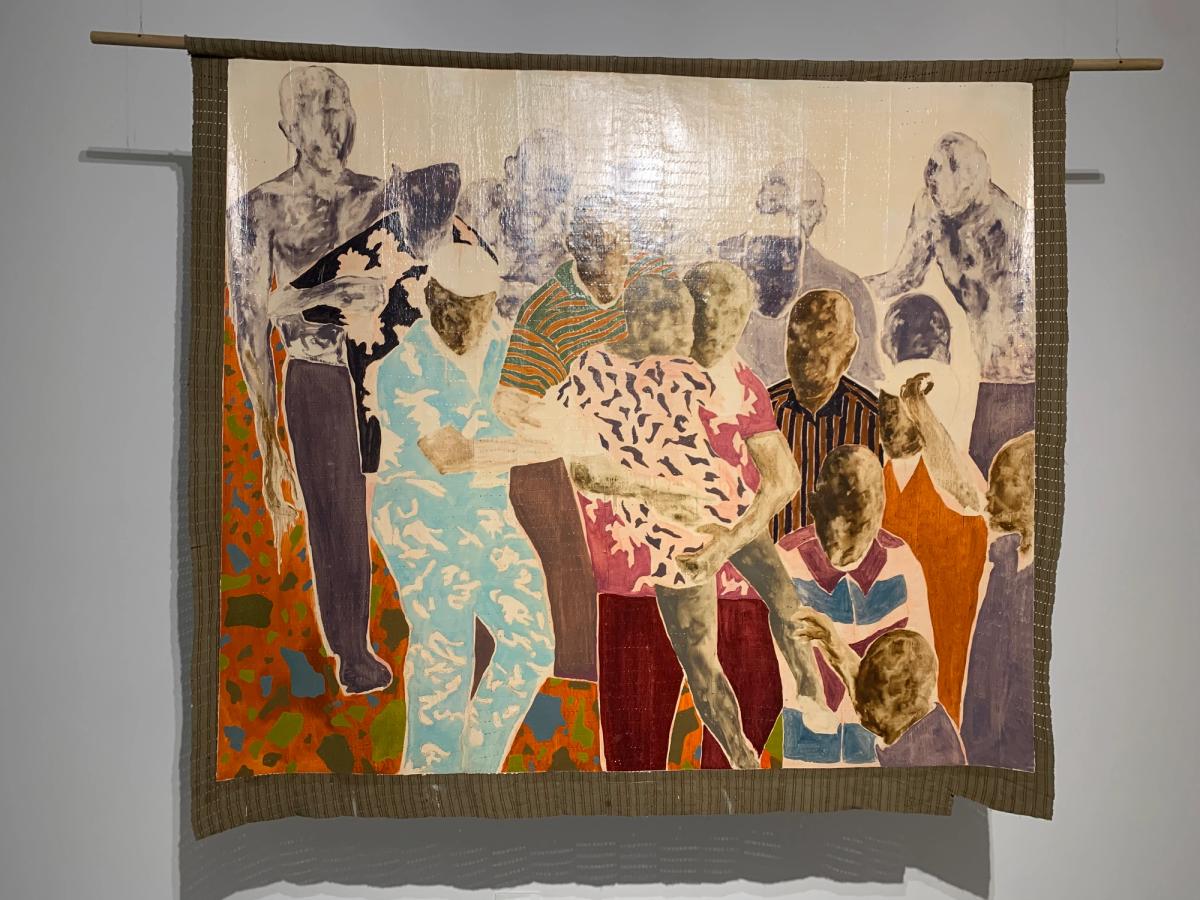
There is a technical detail in Omuku's practice that the broader art press has not fully reckoned with: she paints on the reverse of the sanyan. The visible face of the textile, the face that carried the pattern, the face worn toward the world in ceremonial dress, is turned away from the viewer. What she applies oil paint to is the underside, the structural surface, the woven matrix that made the visible beauty possible but was never itself displayed.
This is not a minor decision. It is, in the PLCFA reading, a curatorial act within the making of the work itself. Omuku preserves the original face of the textile intact while using the obverse as her support. The painting and the tradition coexist in the same object without either consuming the other. The sanyan has not been destroyed to become a canvas; it has been extended, given a second face that looks forward while the first face continues to hold the cultural record it always held. This is the Custodian's Contract enacted at the level of technique: the artist as steward of the material, not its sovereign.
The practical consequence for the object's future is significant. A collector who owns an Omuku holds a double-sided artifact: oil on gessoed sanyan reverse, with the original woven surface intact on the other side. The question of how to display, store, conserve, and eventually transmit this object is more complex than it first appears. The sanyan face has its own claims, its own vulnerability, its own relationship to light and humidity and the passage of time. The object refuses the simplicity the market prefers, and this refusal is a formal one. It cannot be resolved by a reframe or a better press release. It is woven into the structure of the work.
Conservation is also custodianship. A collector who takes on an Omuku painting takes on an obligation to preserve not merely the painted surface but the ceremonial object that underlies it. The Burden of Preservation here is doubled: both the image and the fabric require attention calibrated to their specific vulnerabilities. This is what distinguishes a material covenant from an aesthetic preference. A preference can be overridden; a covenant imposes obligations on whoever holds the object, regardless of what the next auction record suggests the object is worth.
IV. Utopia as Structural Argument
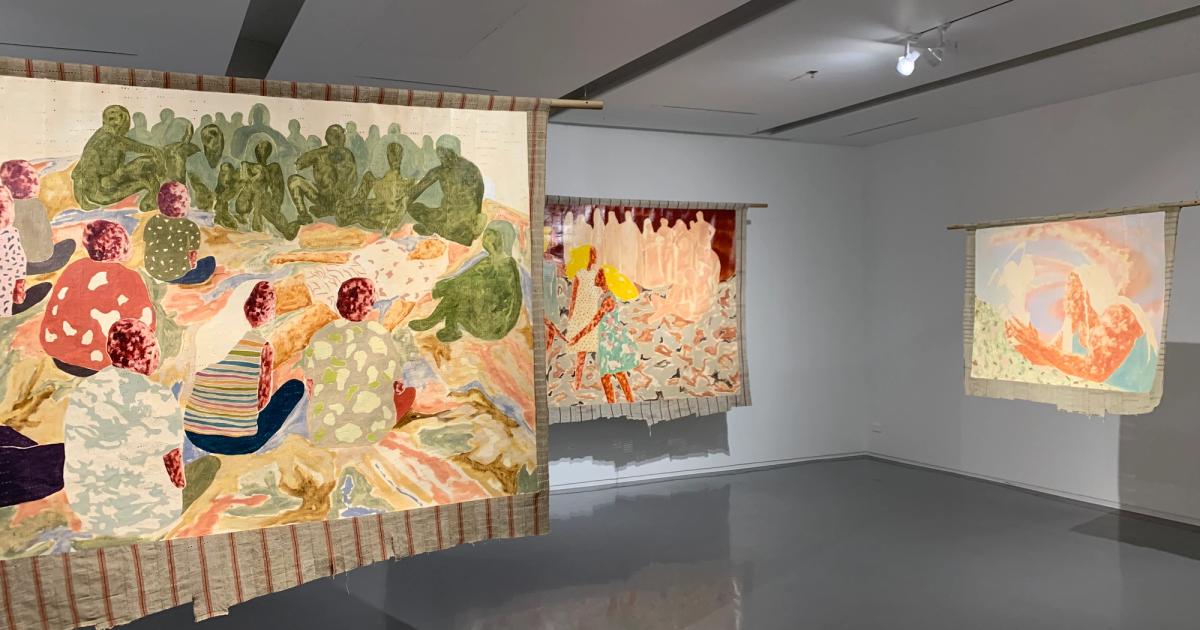
The figures in Omuku's paintings do not have faces. They gather in gardens, along waterways, at the edges of forests that look nothing like Lagos and everything like the city she is imagining. Her palette runs to the Fauvist end of the spectrum: high-keyed greens, warm yellows, blues that tip toward ultraviolet. The scenes are recognizable as groupings, as communities, as arrangements of bodies oriented toward each other rather than toward the viewer. The press description of this work as "utopian" is not wrong, but it tends to reduce what is a precise structural argument to a mood or an aesthetic aspiration.
Omuku's utopian vision is not escapist. It is a claim about what collectivity looks like when it is not organized by the priorities of extraction and financial return. Her faceless figures are not individuals competing for visibility; they are a community, porous at the edges, merging with the landscape they inhabit. The garden they occupy is not a retreat from the city but a reimagination of it. Lagos as it might be structured if the principles governing it were care, beauty, and mutual recognition rather than density, speculation, and the inequality those conditions enforce.
This is where the Semantic Burden of her work concentrates. Sanyan is not politically neutral. Its history as ceremonial cloth, associated with royalty and the Yoruba social hierarchy, with events of collective significance rather than individual display, means that using it as a support imports a specific set of cultural associations into the image. Omuku's utopian figures, placed on this substrate, become figures imagined from within the tradition rather than looking back at it from the outside. The longing she names is not sentiment. It is a structural orientation toward a cultural inheritance that no auction house can partition and no speculative market can price in isolation from its origins.
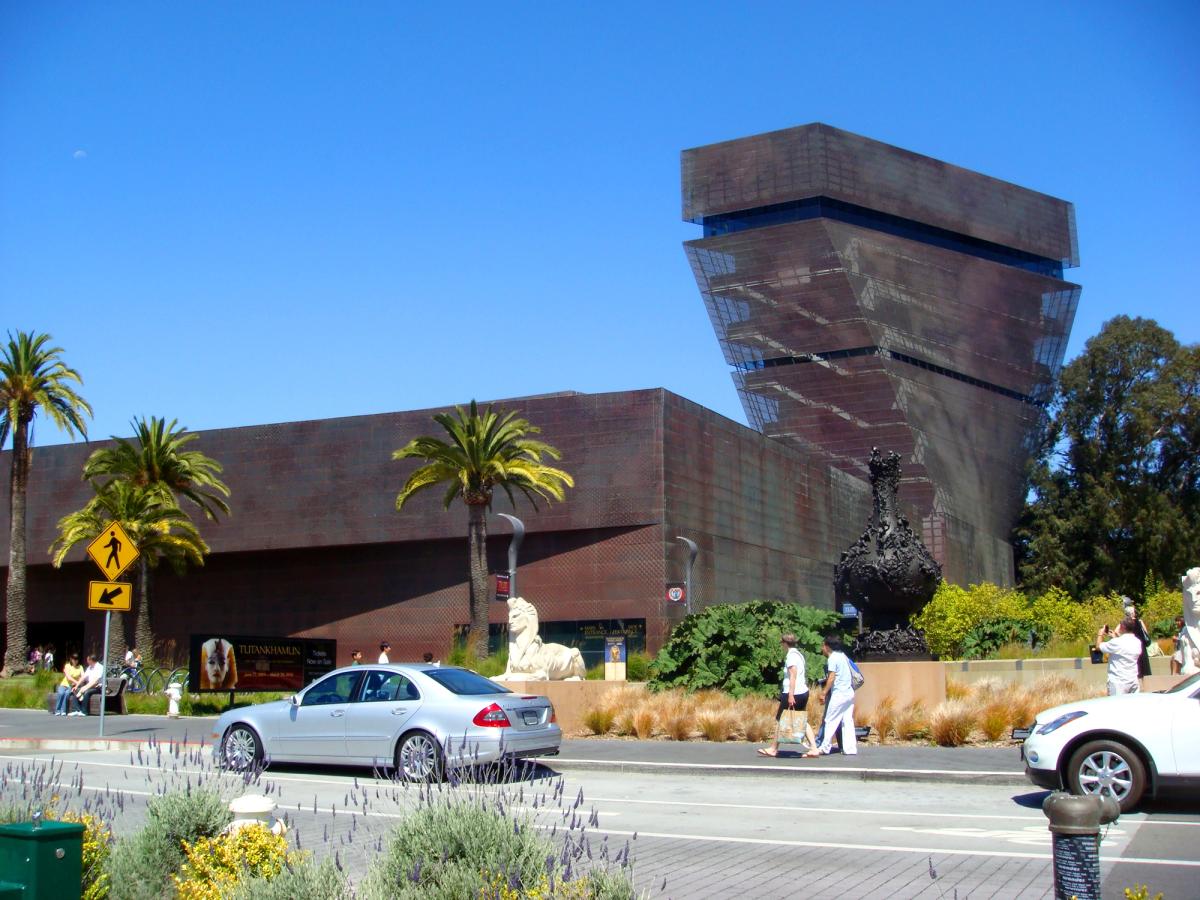
The exhibition series at the de Young Museum, "The Gathering," makes this curatorial logic explicit. Omuku's new paintings are installed within the museum's African art gallery alongside 19th-century guardian reliquary sculptures from the Obamba people, 20th-century Asante Kente cloths, and ceremonial masks and costumes. The juxtaposition is not merely art historical positioning. It places Omuku's contemporary oil paintings in the same material and cultural lineage as objects the museum has preserved under institutional custody for generations. Her sanyan paintings are proposed as their own kind of reliquary: not objects that memorialize a completed past but objects that carry that past forward into an imagined future while the market assigns a price to the journey.
V. Speculative Velocity Arrives
The Sotheby's London result in October 2023 was not Omuku's first sale above estimate, but it was the sale that marked a qualitative shift. Love-Life-Bleeding (2021) at the Modern and Contemporary African Art sale: £22,860, hammer, against a pre-sale estimate of £5,000 to £7,000. The work sold for 3.81 times the mid-estimate, or 3.26 times the high estimate. By the standards of the contemporary art market in a category experiencing sustained institutional attention since the early 2020s, this is not exceptional. What it marks is the moment when Omuku's work entered the asset-class conversation in earnest.
Before that threshold, her work had a price point that allowed collectors to engage with the practice on its own terms: as a specific material proposition, a painting on sanyan, an object that rewards careful looking and careful custody. After it, the work enters a different conversation. The price history becomes part of the object's meaning for a significant portion of the people in the room when the next sale is announced. The bidder is not primarily making a judgment about sanyan and oil paint and the labor of a Nigerian weaving collective. They are making a judgment about where the price history is going. This is the precise mechanism of Speculative Velocity: the financial abstraction of the object accelerates past the object's own capacity to impose its material claims on the transaction.
The institutional acceleration around Omuku's work has been rapid and coordinated. In May 2026, Pippy Houldsworth Gallery in London presented "We Were Like Those Who Dreamed," her second solo exhibition with that gallery, exploring the politics of green spaces in dense urban centers. In September and October 2024, Kasmin Gallery in New York presented "Wild Things and Perennials," comprising eight new paintings on sanyan. Then, in June 2026, the de Young Museum in San Francisco opened "The Gathering," her inaugural U.S. solo museum presentation. Three major institutional moments in less than two years. Each one raises the floor. Each one also raises the velocity.
The Hollowed Object is not destroyed. It retains its physical form: the sanyan, the gesso, the oil, the labor of the weaving collective, the double-sided structure of the artifact. What is eroded is the primacy of the material covenant in the transaction that determines its next home. The collector who acquires at 3.81 times the mid-estimate is not primarily acquiring a relationship to a living textile tradition. They are acquiring a position. Whether that position leaves space for the covenant to continue doing its work, or whether the covenant is progressively reduced to a provenance note in the auction catalog, is the question OAC is watching.
The broader category compounds this pressure. "Contemporary African art" has become a recognized speculative vehicle over the past decade, with auction results for a small number of artists driving significant capital into a market segment that galleries and auction houses have been actively developing. This has produced real benefits for working artists and for the broader visibility of artistic practices from the continent. It has also produced the conditions under which a practice as materially specific as Omuku's can be reframed as an instance of a broader asset class, where the specific cultural weight of sanyan becomes a secondary consideration next to the category's overall performance curve. This is Institutional Necrophagy operating at the level of market categories rather than individual institutional actors: the systemic consumption of cultural specificity by the financial frame that arrives to amplify it.
VI. "The Gathering" and the Museum as Custodian
On June 27, 2026, the de Young Museum in San Francisco opened "The Gathering," Nengi Omuku's first U.S. solo museum exhibition. The show runs through May 2028, an unusually extended tenure for a contemporary artist's inaugural institutional presentation in the United States. Eight paintings are on view, four created specifically for the exhibition, the others selected from recent production.
The curatorial decision to install Omuku's work within the African art collection rather than in a dedicated contemporary gallery is the most consequential element of the show's design. It places the sanyan paintings in proximity to the objects that established the cultural legitimacy of the material itself: Kente cloths, ceremonial masks, guardian reliquary figures from the Obamba people. The museum is asserting a lineage, and that lineage does precisely what the market's price history cannot do. It insists on the cultural depth of the object as its primary value, proposing that the sanyan paintings are best understood not as instances of contemporary African art as an asset class but as participants in a centuries-long material tradition that the museum has an obligation to transmit intact.
This is institutional custodianship enacted at scale, and it functions as a direct counter-register to the acceleration of Speculative Velocity in Omuku's market. Museums do not deaccession works on the basis of auction performance. They do not respond to quarterly returns. They operate on the logic of Narrative Permanence: the object's meaning is constructed and maintained over generational time, not over the cycle of a single market conversation. By placing Omuku's paintings in this context for nearly two years, the de Young is proposing a different temporality for the work's reception, one measured in institutional decades rather than auction seasons.
The risk is not small. Institutional validation is itself a driver of Speculative Velocity. A solo museum show is a credential event; it changes the price floor; it signals to the secondary market that this artist is now museum-grade, which is indistinguishable in the financial register from asset-grade. The museum and the auction house are not adversaries. They are components of the same ecosystem of cultural valuation, and what the museum certifies, the auction house prices. The paradox that Omuku's work now occupies is this: the institutional recognition that most fully honors her material covenant is also the institutional recognition that most accelerates the market forces threatening to overwrite it.
The long run duration of "The Gathering" may be the most honest response to this paradox available to a museum in 2026. Two years of installation within the African art collection, alongside objects that predate the contemporary art market by centuries, is a statement about which temporality the institution believes governs this work. Whether the market agrees is a separate question, one that will be answered in future auction rooms rather than in gallery catalogs.
VII. What Cannot Be Commissioned
The thing that cannot be purchased at auction, and that Speculative Velocity cannot abstract away regardless of how far the prices run, is the commissioning relationship between Omuku and the Nigerian weaving collective that produces her sanyan.
This is a living supply chain. It sustains the knowledge of sanyan production at a moment when that knowledge is economically precarious. The traditional textile industry has contracted significantly across West Africa under the compound pressure of cheap imported cloth, industrial substitution, and declining demand for hand-produced ceremonial fabric in contexts increasingly oriented toward global consumer goods. The weavers who maintain the hand-spinning and hand-weaving techniques required to produce genuine sanyan are fewer than they were a generation ago. Omuku's practice does not merely reference this tradition; it actively funds and extends it. The paintings exist because the weavers do, and the weavers continue to practice because the paintings require them. This is not a narrative that gallery representation invented. It is a structural fact about how her studio operates.
This is the One Original Principle made materially explicit: the impossibility of separating the object from the conditions of its making. You cannot reproduce an Omuku painting by substituting a commercially woven fabric, or by sourcing sanyan from a different weaving community that uses different techniques and different thread materials. The material specificity is constitutive of the work's meaning, not incidental to its appearance. A forgery would be detectable not merely by technical analysis of the paint layers but by material analysis of the fabric: the wrong thread, the wrong weave structure, the wrong production relationship tells the wrong story. The object's authenticity is not solely located in the artist's hand. It is also located in the weaver's loom.
This custodial relationship is what distinguishes Omuku's practice from the broader category of contemporary artists who reference African material culture without substantively engaging with its production. The sanyan is not a visual idiom borrowed for its associative richness. It is a living covenant between the painting and the people who make the material possible, one that requires ongoing maintenance, ongoing commissioning, and an ongoing financial relationship between the artist's practice and the craft economy that sustains the substrate. The Object Permanence that results is not metaphorical. It is grounded in the specific, irreproducible labor of specific hands, in a specific tradition, in a specific country, that Omuku has chosen to sustain rather than merely represent.
What does this mean for the collector? It means that holding an Omuku is not equivalent to holding a position in a market category. It is closer to holding a responsibility. The object carries a material history that extends well before the artist's studio and a cultural claim that extends well beyond the auction record. Whether the collector understands this when the hammer falls is not something the price can determine. It is something the material covenant asks of the person who receives it. The Zero-Sum Aura of the speculative transaction, in which the cultural weight of the object is consumed by its financial abstraction, is the outcome Omuku's practice is structured to resist. The art market can price the resistance. It cannot dissolve it.
Coda
Nengi Omuku is not producing utopian paintings. She is producing objects that enact the conditions utopia requires: shared labor, custodial inheritance, material covenants that survive the individual and outlast the market cycle. The sanyan is not a metaphor for these conditions. It is their proof, woven into the structure of the support before the first mark is made.
What OAC registers here is not optimism about the outcome. Speculative Velocity has a strong track record. The emerging artist who establishes a material practice rooted in cultural depth and custodial seriousness is not protected from the moment when that practice becomes a price point. The question is whether the material itself, the specific hand-woven, actively commissioned, culturally loaded sanyan, can maintain its claim on the object's meaning after the market has made its claim on the object's price. This study's position is that the claim survives, but only if the collector who holds the work understands what the holding requires. The paintings will outlast any auction record. Whether the covenant will outlast the price history is the harder question, and the one that makes this practice worth watching with critical attention rather than market enthusiasm.