Yaacov Agam: The Object That Cannot Be Fixed
On the artist who built instability into the work, the market that tried to price it anyway, and the custodians left with something that refuses to stay still
The Kinetic Life
Yaacov Agam died in Paris on June 21, 2026, aged 98. He was born on May 11, 1928, in Rishon LeZion, a city south of Tel Aviv, the son of a Kabbalist rabbi. He died in the city where he had lived since the early 1950s, where he had studied, staged his first solo exhibition in 1953, and where the European art world had slowly caught up with what he was doing. For his long career, he received the Israel Prize, the highest civilian honor in Israel. Paris shaped the reception of his work. But the question he spent that work answering was not European. It was theological.
The prohibition on graven images in Jewish tradition is usually read as a restriction. Agam read it as a proposition. If you cannot represent the divine in a fixed and singular form, what kind of form can you use? An object that changes as you move around it, that reveals a different face depending on the angle of approach, that synthesizes into something new when you stand directly in front of it: this is not a violation of the prohibition. It is its fulfillment. The image exists in time and in the relation between object and perceiver. It cannot be worshipped because it cannot be fixed.
This is where Agam begins. It is also where his legacy becomes most difficult for the art market to process. The market requires a fixed object with a legible identity: a singular image that can be photographed, catalogued, and priced. Agam made objects that resist every step of that sequence. In his death, the market is confronted with the full weight of what that resistance means for those who hold these works.
Formation: From Rishon LeZion to Paris
Agam's education combined two disciplines that proved generative in his hands. At the Bezalel Academy of Arts and Design in Jerusalem, he received a grounding in the formal traditions of Israeli art and design. In Zurich, at the School of Arts and Crafts, he studied under Johannes Itten, the painter and former Bauhaus master whose color pedagogy treated form as a field of forces rather than a set of fixed properties. Itten taught Agam to think about color and form as dynamic systems. Agam carried this further: if color theory describes how colors interact, what happens when the viewer moves through that interaction, when time and position become variables in the equation?
He arrived in Paris in 1951 and connected with an emerging network of artists who were thinking about art in relation to movement, time, and the viewer's participation: Yves Klein, Jean Tinguely, Victor Vasarely. The group that would eventually cohere under the banner of the Nouvelle Tendance and, later, kinetic art. Agam was in this company but not reducible to it. Where Tinguely made machines that dramatized their own failure, and Vasarely pursued optical effects in flat pictorial space, Agam was concerned with something more specifically theological: the object that cannot be seen completely from any single position.
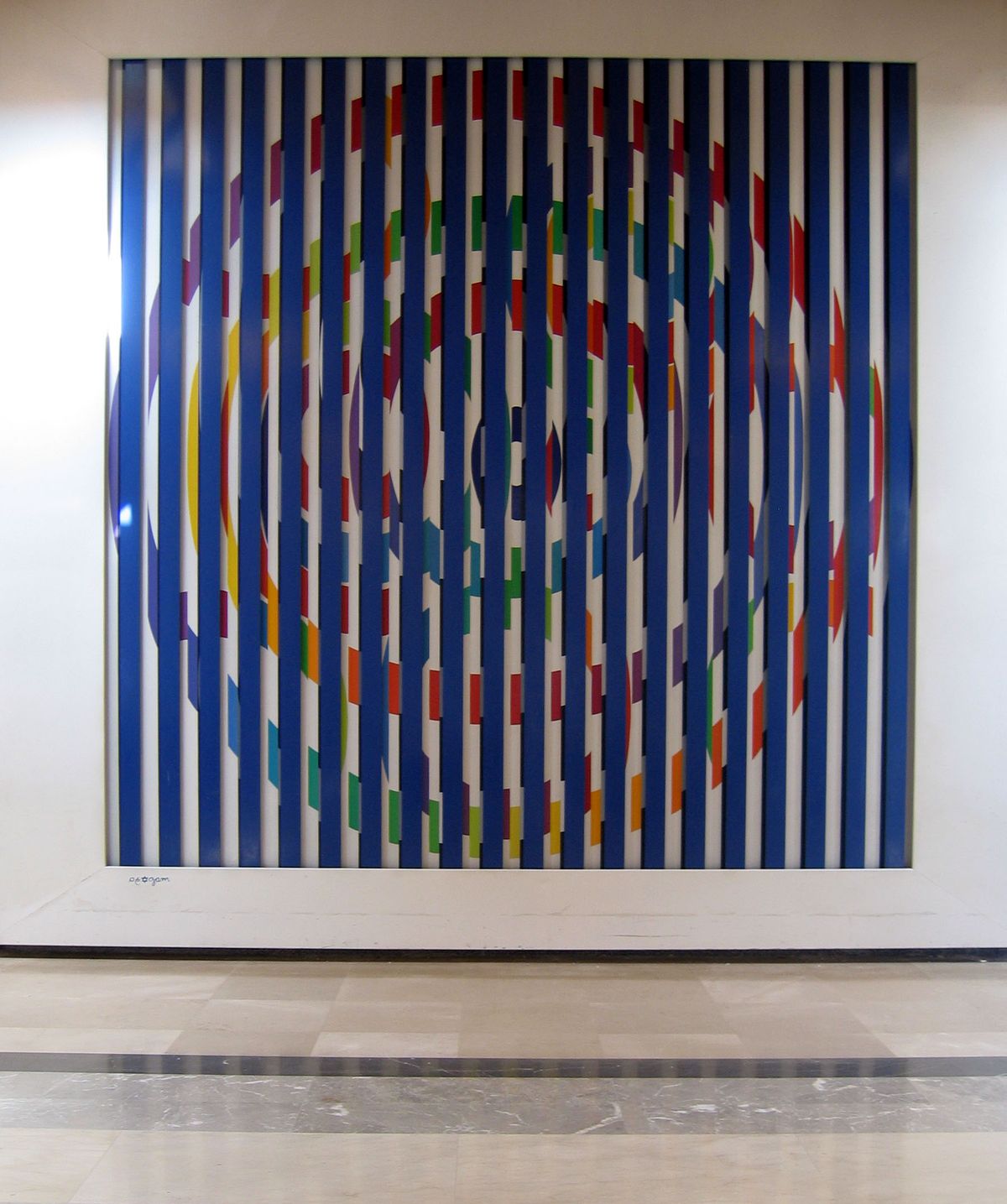
His first solo exhibition, at Galerie Craven in Paris in 1953, was among the first anywhere in which the viewer was structurally required to move to see the work, not invited to interact as a supplementary pleasure, but required to move as a condition of the work's existence. If you stood still, you saw one image. If you moved left, another. If you walked past, both became a third. The synthesis occurred only in motion. The object was not the work; the encounter was the work.
The Agamograph: Material Singularity and the Question of the Original
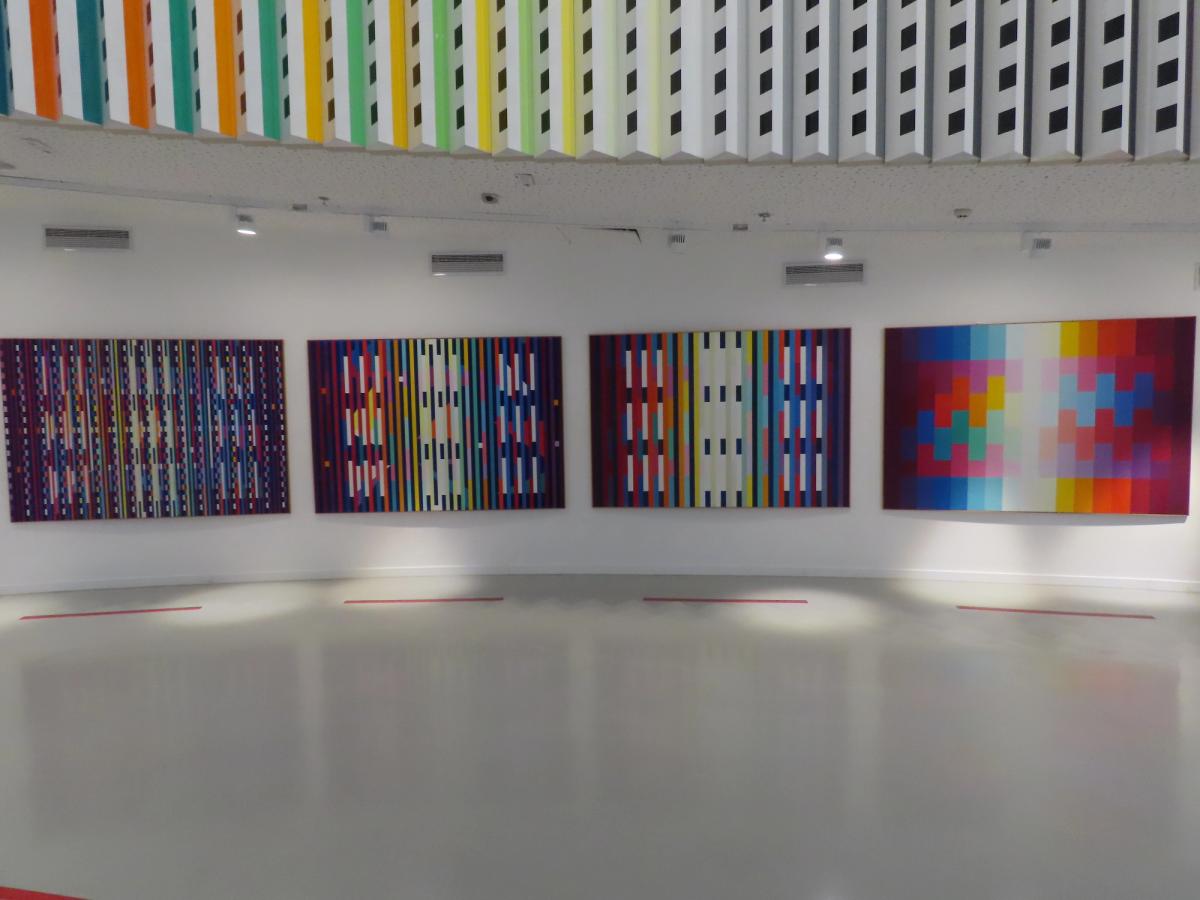
The form most associated with Agam's name in the secondary market is the Agamograph: a work made on a corrugated surface of vertical ridges, each ridge carrying different images on its left-facing and right-facing sides, with a further image visible from directly in front. Later Agamographs used lenticular printing, a photographic process in which a lens array produces images that shift depending on the angle of view. The lenticular process allowed for greater precision and repeatability. It also introduced a set of problems that would define the critical reception of his print-based work.
Material Singularity, as OAC understands it, is the irreducible material specificity of an object: the quality that makes it this object and not a reproduction. For a painting, Material Singularity is located in the physical marks, the surface, the accumulated decisions of the hand. For an Agamograph made via lenticular printing, the question is structurally more difficult. A lenticular print is, by its nature, a reproduced image; the kinetic effect is produced by the lens array and the images beneath it, both of which can, in principle, be manufactured again from the same specifications. The object is singular in the sense that this physical instance exists, but its effect is not predicated on the singularity of the material substrate in the way that a painting's is.
This is not a criticism of Agam's practice. It is a structural feature of his chosen medium, and it has consequences. When the adhesive layers in lenticular Agamographs begin to delaminate, as documented in several institutional works, the question of restoration becomes a question of ontology: if you replace the lens array from the same digital specifications, is that restoration or reproduction? The Burden of Preservation for these works is unlike the canvas's. The canvas can be cleaned, stabilized, revarnished within a continuous material history. The Agamograph, if it fails at the material level, may require a reconstruction that collapses the distance between original and copy. This is the Hollowed Object risk: the market continues to price the work as singular while the material substrate loses the basis for that claim.
Public and Permanent: The City as Custodian
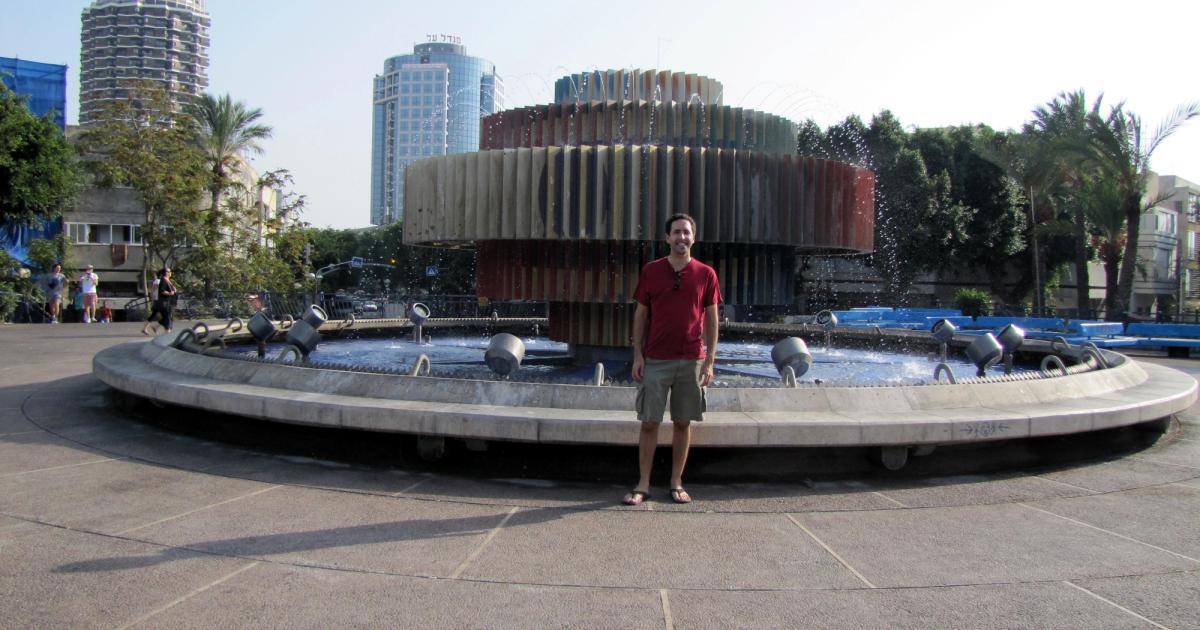
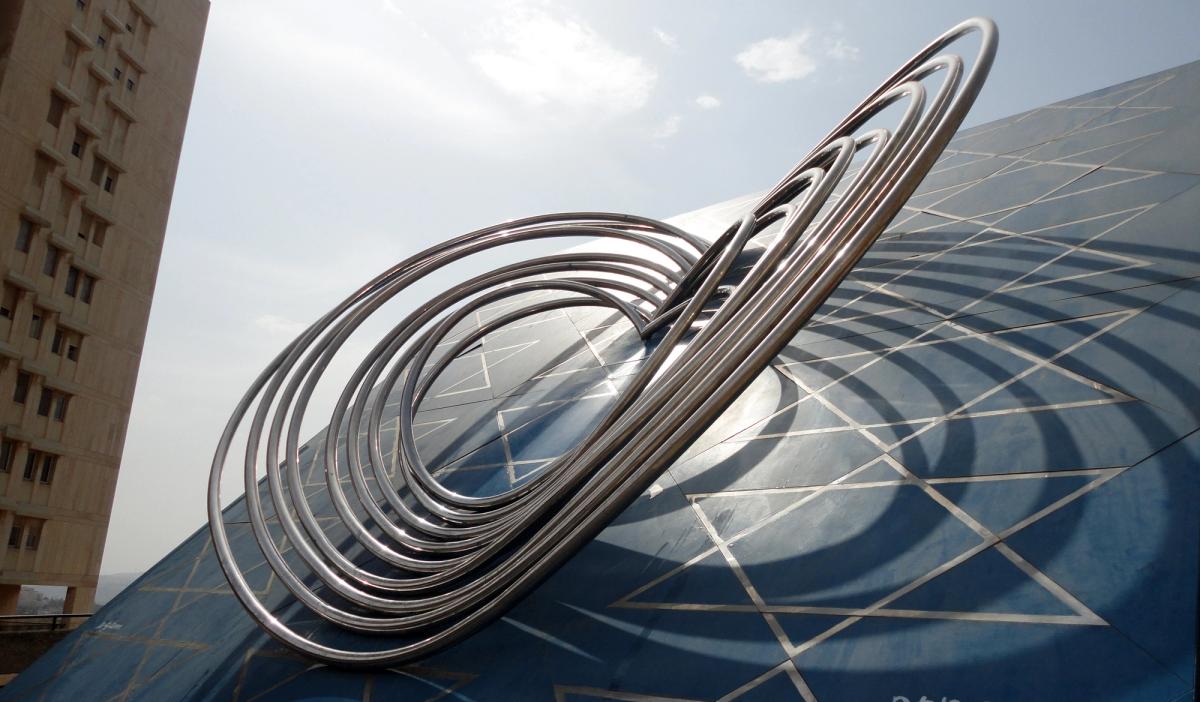
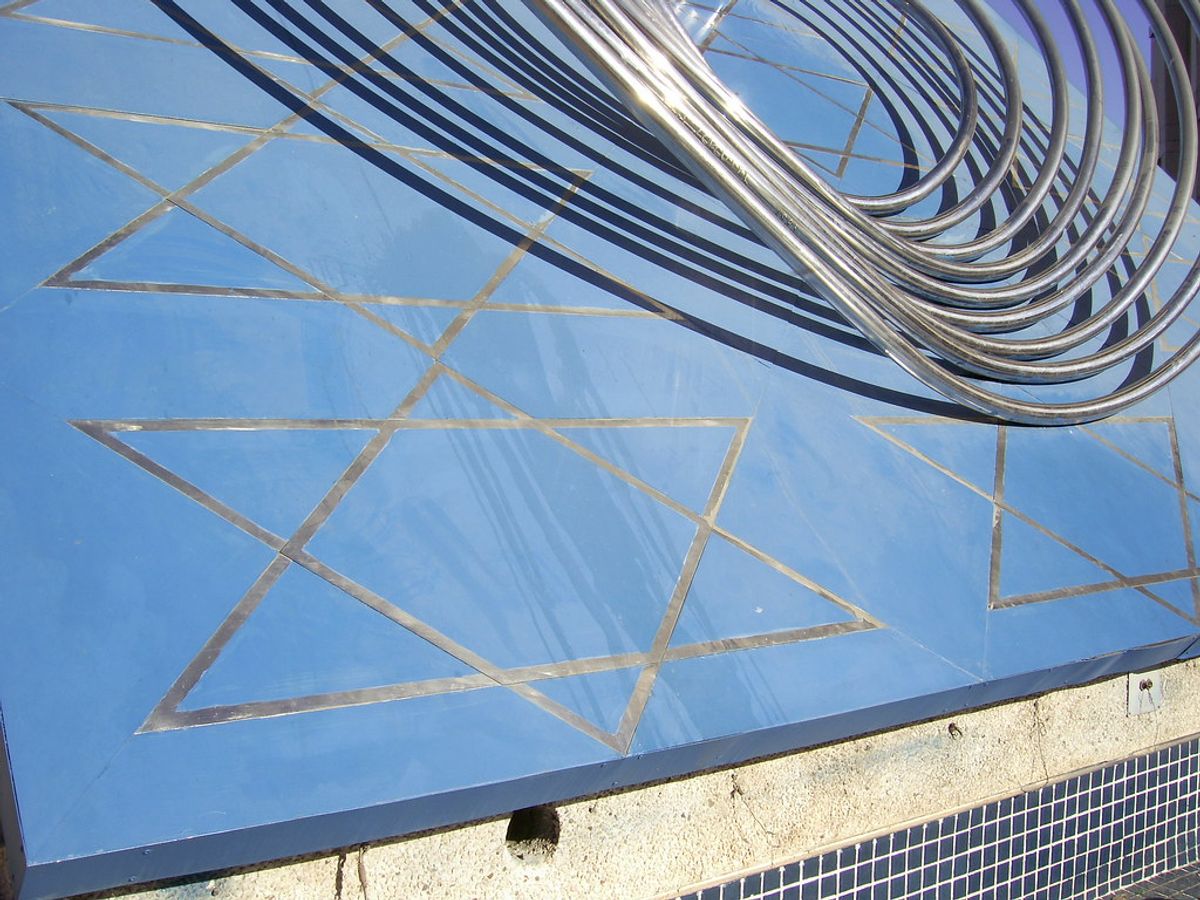
Agam's most enduring works are not the Agamographs. They are the large-scale public commissions: the Fire and Water Fountain at Dizengoff Square in Tel Aviv, inaugurated in 1986; the Star of the Knesset, a kinetic aluminum sculpture at the Israeli Parliament in Jerusalem; the fountain at the Centre National d'Art et de Culture Georges Pompidou plaza in Paris; and Communication X9, a 43-foot prismatic tower at 150 North Michigan Avenue in Chicago, installed in 1983. These works function differently from the Agamographs in market terms because they were never in the market. They were commissioned directly, placed in public space, and entrusted to civic or institutional custodians.
This is the Custodian's Contract at scale: the artist delivers a work designed for a particular site and set of conditions, and the civic body takes on the obligation to maintain it and keep faith with its original intent. The record of that contract is mixed. The Fire and Water Fountain was removed from Dizengoff Square in 2016 during a renovation project that reconfigured the square's grade level. The fountain's kinetic mechanisms, motors, and water systems had required expensive specialist maintenance throughout its history: maintenance that ordinary municipal budgets are not designed to sustain. Its absence from the public realm was treated as a practical matter. By the time Agam died in 2026, it had still not returned. The most celebrated kinetic public artwork in Israel's largest city was in storage.
In Chicago, Communication X9 was removed from its site at 150 North Michigan Avenue by building management in approximately 2018. Agam had previously objected to a 2005-2008 restoration on the grounds that the work's colors had been incorrectly rendered. The subsequent removal by building management left the question of the work's future unresolved. In both cases, the Custodian's Contract held until it was inconvenient. Then it was dissolved by the party that held the physical asset.
Salon Agam: The Palace, the Museum, and the Act of Absorption
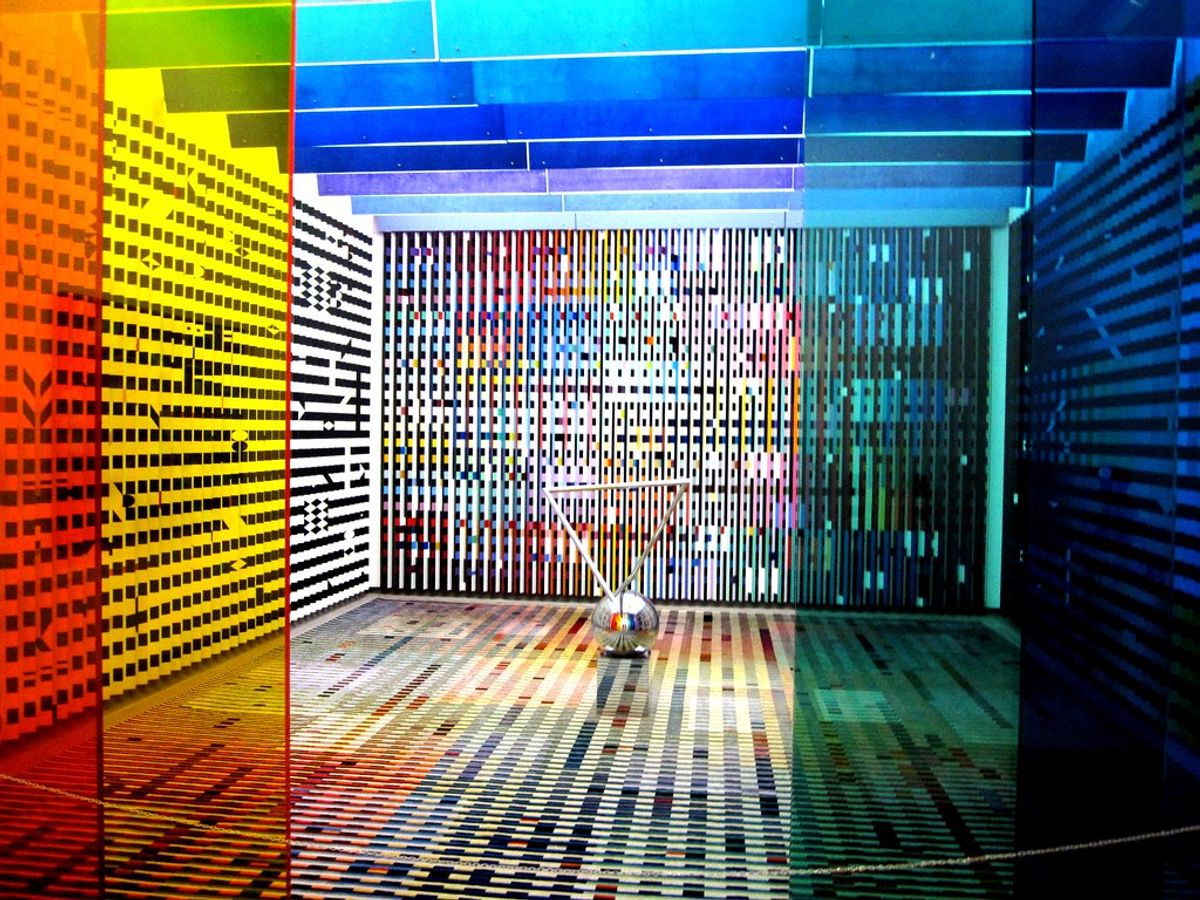
Between 1972 and 1974, Agam designed the antechamber of the private apartments at the Elysee Palace in Paris, at the invitation of President Georges Pompidou. The space was a total kinetic environment: moving colored panels on the walls, a dynamic ceiling, integrated lighting that shifted with the room's use. It was, arguably, the most ambitious kinetic interior ever realized at this level of political and cultural authority. The commission placed Agam at the center of the Fifth Republic's self-presentation at a particular moment in French cultural ambition.
Pompidou died in 1974 before the space was complete to its final specification. His successor, Valery Giscard d'Estaing, had different aesthetic preferences, and the Agam interior was dismantled shortly after he took office. The components were reassembled and placed in a dedicated room at the Centre Georges Pompidou, which opened in 1977 and was named for the president who had championed its creation. The Salon Agam, as it is now known, has been a permanent installation at the museum ever since.
This is a version of what OAC has identified as Institutional Necrophagy: the institution that absorbs the challenging work, places it in an archive, and makes it safe for a public that visits rather than inhabits. The Salon Agam was designed for a living political space, a room that served as the antechamber to the most powerful office in France. In that context, its kinetic unsettledness was a statement about the conditions of power and perception. In the Pompidou's gallery rooms, it becomes a historical document. The challenge is neutralized by the museum's capacity to frame and contain. As this institution analyzed in its study of MoMA's absorption of Duchamp, the museum's power to domesticate is proportional to the radicality of what it absorbs. The more destabilizing the work, the more the institution's containment apparatus earns its authority by housing it.
Speculative Velocity and the Post-Mortem Market
Agam's secondary market was active for decades before his death, driven primarily by the Agamographs and a series of limited-edition prints and multiples that made his kinetic effects available at accessible price points. This accessibility was a deliberate strategy: Agam believed that art should reach people who were not collectors, that the kinetic experience should not be confined to the walls of a few wealthy apartments. The editions, the open prints, the objects sold at art fairs alongside the major studio works, were part of a democratic impulse whose market consequences he may not have fully anticipated.
The market processed this democratic impulse as an opportunity for tiering. Large, unique studio works commanded prices that placed them alongside significant works of European modernism at auction. Limited editions occupied a middle market. Open editions sold at the low end of the secondary market, through galleries and dealers catering to buyers who wanted the kinetic experience without the collecting-level commitment. The system was internally coherent, but it created a structural vulnerability: the existence of widely available open editions made it difficult to sustain Narrative Permanence for any individual work in the format, because the story of the object could not be separated from the story of the format's reproducibility.
Agam's death triggers the market mechanism OAC has analyzed as Speculative Velocity: the post-mortem surge in secondary market pricing that treats the artist's death as a supply constraint and prices accordingly. For an artist whose output spanned unique studio works and mass-produced editions, this creates a particular instability. The supply constraint applies to one category; the mass-market category is unaffected. The Zero-Sum Aura distributes unevenly: it concentrates on the unique works and the important commissions, while the editions hold or decline as the distinction between open and limited becomes the operative question collectors and dealers have avoided asking for decades.
The market's demand for a singular, stable, photographable asset form meets Agam's work at exactly the point where his work refuses all three of those qualities simultaneously.
The Burden of Preservation: What It Costs to Keep a Moving Object Moving
The conservation of kinetic art is a specialist discipline that developed largely in response to the problems created by the postwar kinetic movement. Motors fail. Cables corrode. The mechanisms that produce movement in a mid-century kinetic sculpture may no longer be manufactured. Lenticular lens arrays use adhesives that can delaminate over decades. The interactive elements of works designed for bodily participation require maintenance not just of the physical object but of the conditions of encounter: adequate space for the viewer to move, lighting calibrated to the kinetic effect, staff who understand what the work is supposed to do and how to distinguish a damaged state from an intended one.
This is the Burden of Preservation at its most literal: the custodian of a kinetic work does not merely preserve an object but maintains a process. The difference matters in institutional and financial terms. A painting's conservation budget is bounded; you can estimate the costs of cleaning, reframing, and climate-controlled storage over the long term. A kinetic work's conservation budget is open-ended. You are maintaining a machine, and machines break in unpredictable ways. The Fire and Water Fountain's removal from Dizengoff Square in 2016 was, at one level, a decision about the cost of that maintenance relative to the perceived value of keeping faith with the Custodian's Contract. The municipality chose the budget over the contract. This is not an unusual choice; it is simply an honest account of what civic custodianship means when the machine is expensive and the political will to maintain it has exhausted itself.
The question of who bears the Burden of Preservation across Agam's full public legacy is unresolved at his death. The commissions are distributed across Tel Aviv, Jerusalem, Paris, and Chicago, under the authority of entities ranging from a municipal park department to a private building management company. No single body is responsible for the whole. The estate inherits the moral claim; the civic bodies hold the physical assets. The practical outcome of that division will determine which of Agam's most significant works survive intact into the next century, and which continue to sit in storage while the paperwork circulates.
The Anti-Speculative Entity
Agam's most serious work is structurally resistant to the logic of the speculative market. This is not coincidental; it is a consequence of his central philosophical commitment. An object that exists only in the relation between itself and a moving perceiver cannot be adequately represented by a photograph. It cannot be fully described by a catalogue entry. Its meaning cannot be fixed by a critical essay, including this one. It requires presence, and presence is precisely what the financialized art market systematically substitutes with documentation.
The market can document an Agam; it cannot price what an Agam actually does. It can assign a value to the physical object, the signed print, the studio work with its certificates and provenance. But the kinetic encounter itself, the moment when the viewer moves and the image transforms, the synthesis that exists only in that particular body at that particular angle at that particular time: this is not an asset. It cannot be owned. It can only be experienced. The market prices the substrate and ignores the event. In doing so, it consistently points to the gap between what it says it is pricing and what it is actually leaving out of the transaction.
OAC has analyzed similar dynamics in studies of works whose primary value is experiential rather than material. In each case, the secondary market finds ways to price the substitute: the documentation, the edition, the related print, the object adjacent to the encounter. Agam's practice represents perhaps the most rigorous version of this resistance in the postwar period. The work was designed, from the beginning, to be irreducible to any singular, stable, photographable form. As this institution noted in examining material covenant and custodial obligation in a very different context, the hardest thing any institution can do is maintain what it promised to maintain when maintaining becomes inconvenient.
The theological dimension is not incidental. Agam's refusal of the graven image was not merely aesthetic; it was an argument about the conditions of honest representation, the claim that any fixed image lies because reality is not fixed. The market's insistence on the fixed image, on the document, on the singular asset, is not just an economic preference. It is a representational claim about what an artwork is. Agam spent 70 years making works that refuse that claim. The market spent those same 70 years finding ways to price the refusal anyway, and the refusal survived.
Coda
Agam lived to 98 and made work until very close to the end. The body of work he leaves is genuinely unusual in the history of twentieth-century art: it spans theological philosophy, optical innovation, public monumentalism, decorative interior design, mass-market reproduction, and institutional collection, all organized around a single proposition about the nature of perception and representation.
The proposition is this: that the static object is a convenient fiction, and that honesty requires movement. What this means for those who inherit his work, as custodians, collectors, conservators, and civic authorities, is that they are responsible for maintaining not just objects but conditions: the conditions under which the work can do what it was made to do. A kinetic work in storage is not a work at all. It is a machine waiting to be reassembled. Whether those machines are ever reassembled is the question that will define Agam's legacy in the decades to come, not the auction prices of the Agamographs, not the scholarship on the optical theory, but the simpler and more demanding question of whether the city, the museum, and the collector are willing to maintain what they agreed to maintain.
The object that cannot be fixed is also the object that cannot be abandoned without consequence. It requires perpetual attention. That is, perhaps, the most radical thing about it.